
Mylar Bags for Food Storage: How to Choose, Fill and Seal Them
As an Amazon Associate and member of other affiliate programs we earn a small commission from qualifying purchases through our affiliate link. For more information read our Entire Affiliate Disclosure.
Mylar bags for food storage can protect properly dried foods from moisture, oxygen and light when the bags are carefully chosen, filled and heat sealed. I use them primarily for freeze-dried foods and other dry foods I want to protect for longer storage.
But the bag is only one part of the storage system.
A Mylar bag cannot make damp food safe, turn a perishable food into a shelf-stable food or guarantee that everything inside it will last 25 years. Successful storage begins with food that is appropriate for dry storage and continues with good packaging, a dependable seal and a cool, dry storage environment.
For foods my family will use soon, I often prefer Mason jars or smaller airtight containers. For food intended for deeper storage, a sturdy high-barrier Mylar-style bag with an appropriately sized oxygen absorber may be the better choice.
The goal is not to put every dry food into the most expensive package. It is to match the package to the food, the intended storage time and the way your family will eventually use it.
Editor’s note: Originally published January 2024. This article was reviewed and updated in October 2026 to improve the food-safety guidance, clarify realistic shelf-life expectations and add a complete packaging and sealing process.

What Are Mylar Bags?
Mylar is a trade name for a type of strong polyester film. In the food-storage market, however, “Mylar bag” is often used more generally for a multilayer flexible pouch made with plastic films and a metallized or aluminum-foil barrier layer.
That layered construction is what makes a good food-storage pouch useful. Depending on the particular bag, the layers help provide:
- A moisture barrier: Very dry foods readily pull moisture from the surrounding air. A high-barrier bag helps keep outside humidity from reaching the food.
- An oxygen barrier: Oxygen contributes to oxidation, loss of flavor and color, nutrient deterioration and rancidity in foods containing fat.
- A light barrier: Opaque bags protect light-sensitive food components better than clear packaging.
- Physical protection: A sturdy bag resists ordinary handling, although it can still be punctured or chewed by rodents.
Not every metallic-looking pouch offers the same protection. Bag construction, barrier quality, thickness and the integrity of the heat seal all matter.
When Are Mylar Bags the Best Choice?
Mylar bags are especially useful when you want lightweight, compact packaging for completely dry food that will remain unopened for an extended period.
Good candidates may include:
- Properly freeze-dried fruits, vegetables, meats and complete meals
- White rice
- Dried beans
- Wheat berries and other appropriately dry whole grains
- Rolled oats
- Dry pasta
- Nonfat dry milk
- Other low-moisture, low-oil pantry staples recommended for long-term dry storage
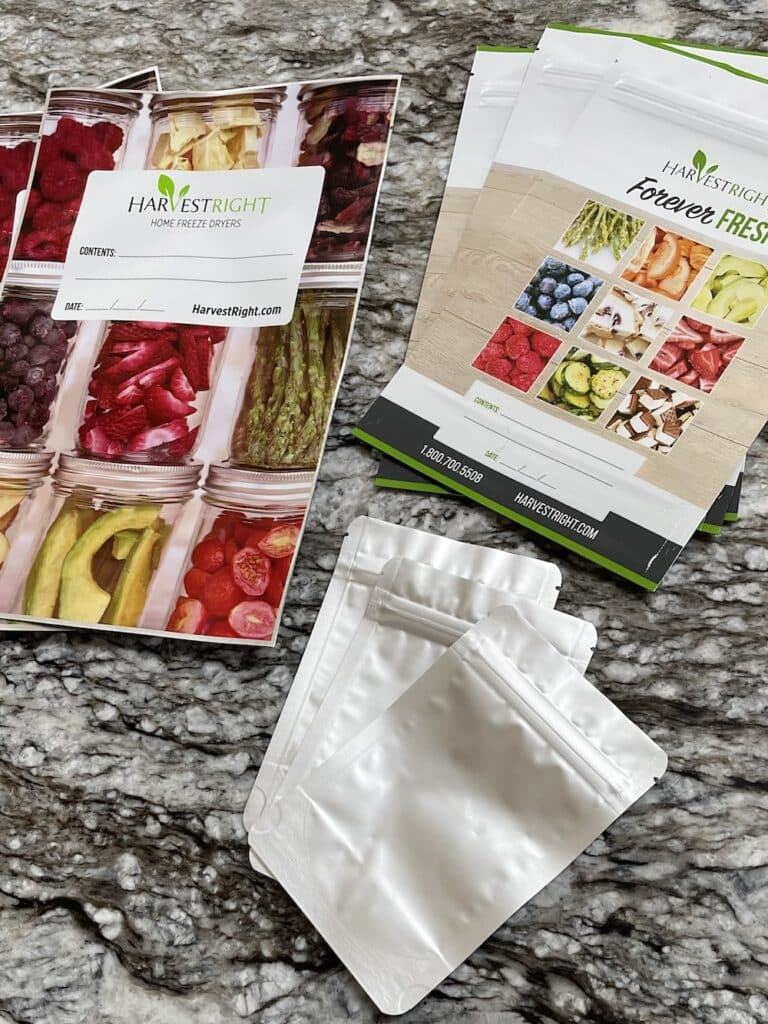
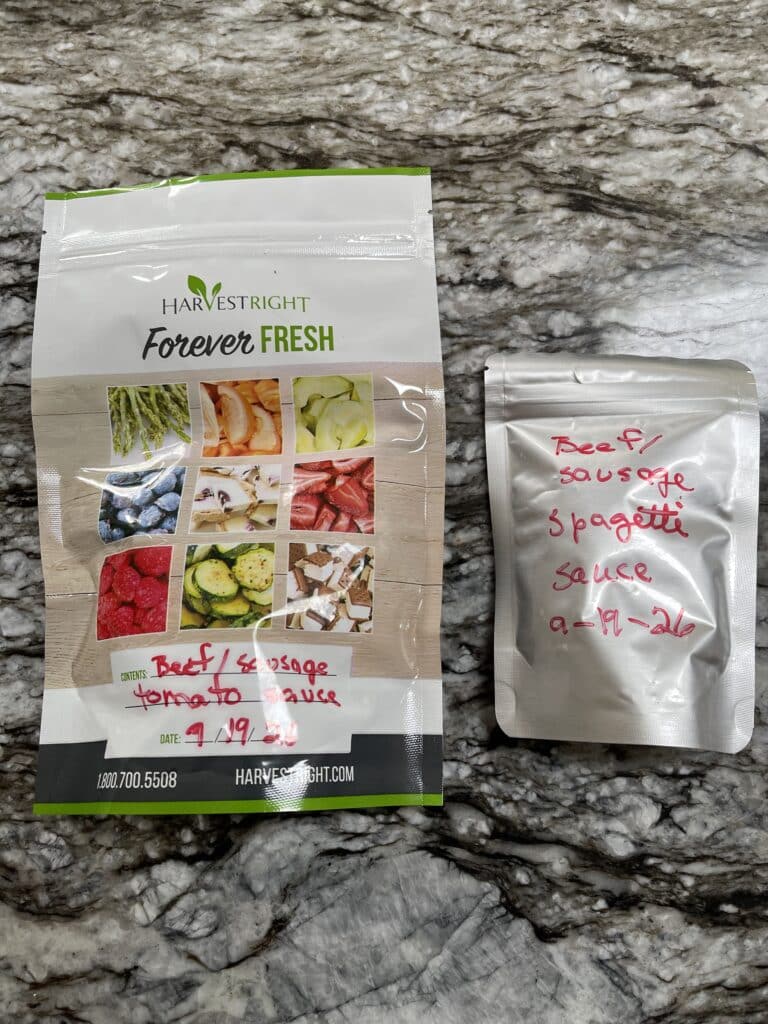
Small Mylar pouches are also convenient for individual servings of homemade freeze-dried meals for camping, travel or emergency supplies. A properly chosen pouch can protect the food and later serve as the container for rehydrating and eating the meal.
Mylar Is Not Necessary for Every Dry Food
Before opening a new bag, ask how soon you expect to use the food.
Foods and snacks your family will use within weeks or a few months may need only a clean, dry, airtight pantry container.
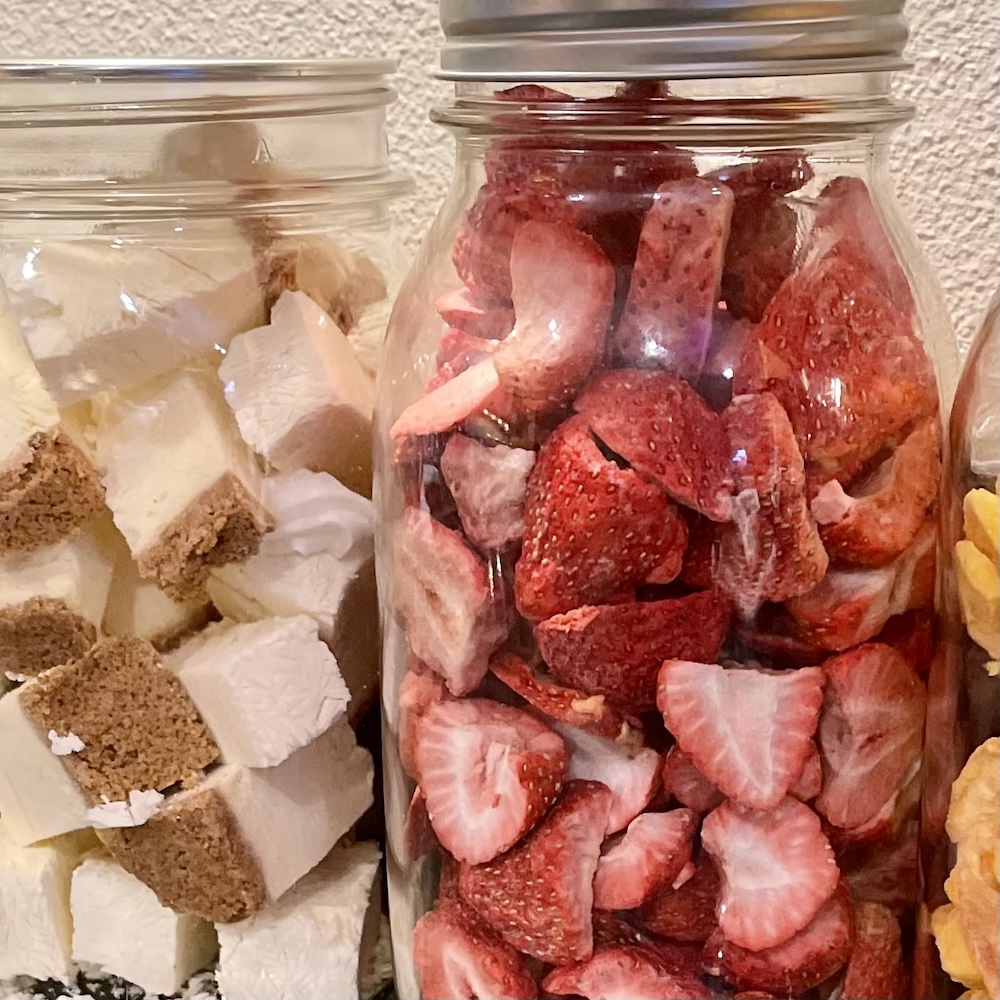
Freeze-dried food that regularly moves through your kitchen may fit well in a Mason jar or smaller airtight container kept away from light and humidity.
Food intended to remain unopened for longer storage is a better candidate for a high-barrier Mylar-style bag with appropriate oxygen control and a dependable heat seal.
Bulk dry staples can be divided among smaller Mylar bags or placed in a high-barrier liner protected inside a food-grade bucket or sturdy tote.
Packaging food in smaller usable quantities also keeps you from exposing an entire large supply to humid air every time you need one cup or one serving.
For a complete comparison of jars, bags and other storage options, see our guide to short- and long-term freeze-dried food storage.
What Should You Not Store in Mylar Bags for Long-Term Shelf Storage?
Do not use a Mylar bag to make an unsafe food shelf stable.
Avoid packaging the following for room-temperature storage unless the food has first been preserved by an appropriate, research-based method:
- Fresh or raw foods that ordinarily require refrigeration
- Liquids and moist foods
- Incompletely freeze-dried food
- Home-dehydrated food that remains soft, pliable or moist inside
- Jerky or other dried meat that has not been specifically prepared and validated for the intended storage method
- Food with uncertain moisture content
- Any food showing mold, spoilage or contamination
High-fat foods present a different problem. Nuts, brown rice, whole-grain flour, granola, full-fat dairy powders and many meat or egg products can develop rancid flavors much sooner than low-fat dry staples.
A Mylar bag and oxygen absorber may slow oxidation, but they do not give every fatty food a decades-long shelf life.
These foods may still be packaged in Mylar for an appropriate shorter period. The important point is not to treat “stored in Mylar” as another way of saying “good for 25 years.”
The Most Important Safety Rule: Package Only Adequately Dry Food
Removing oxygen is not, by itself, a food-preservation method.
Moist food sealed into a reduced-oxygen package can become unsafe. Some dangerous microorganisms, including Clostridium botulinum, can grow under low-oxygen conditions when the food provides enough available moisture and other conditions support growth.
You may see 10 percent moisture given as a general limit for certain dry storage staples. That can be useful industry guidance, but it is not a universal home-kitchen test for every food.
Moisture content and water activity are related but different measurements, and neither can be accurately judged simply by looking at a product.
For home freeze-dried food, check several of the thickest and densest pieces from different areas of the tray. Break them open and look and feel for cool, soft, gummy or damp centers. If you are uncertain, return the food to the freeze dryer for more dry time.
Never add an oxygen absorber or desiccant in hopes that it will finish drying questionable food inside the package.
Our Freeze Drying Food Safety guide explains this principle in more detail.
How to Choose Good Mylar Food Storage Bags
The cheapest bag is not a bargain if it develops pinholes, tears during normal handling or will not hold a seal.
Here are the features I look for.
Food-Contact Suitability
Choose bags from a reputable supplier that are specifically labeled for food storage. A decorative metallic pouch is not automatically suitable for direct food contact.
High-Barrier Construction
For longer storage, choose opaque, multilayer bags intended to block oxygen and moisture.
Fully opaque bags also protect food from light. Bags with clear windows can be convenient for candy and short-term products, but I do not prefer them for deep storage.
Sturdy Thickness
Thicker bags generally resist punctures and rough handling better than thin bags.
For freeze-dried foods intended for longer storage, I generally look for sturdy bags in approximately the 5- to 7-mil range or heavier.
Compare specifications carefully. Suppliers do not always describe thickness in the same way. One may report the thickness of one wall while another reports the combined bag thickness.
Barrier construction and seal quality are also important, so the largest “mil” number does not automatically identify the best bag.
A Heat-Sealable Top
Choose a bag with enough clean material above the food or zipper to make a wide, dependable heat seal.
A zipper is convenient after the bag has been opened, but it is not a replacement for heat sealing during long-term storage.
A Useful Size
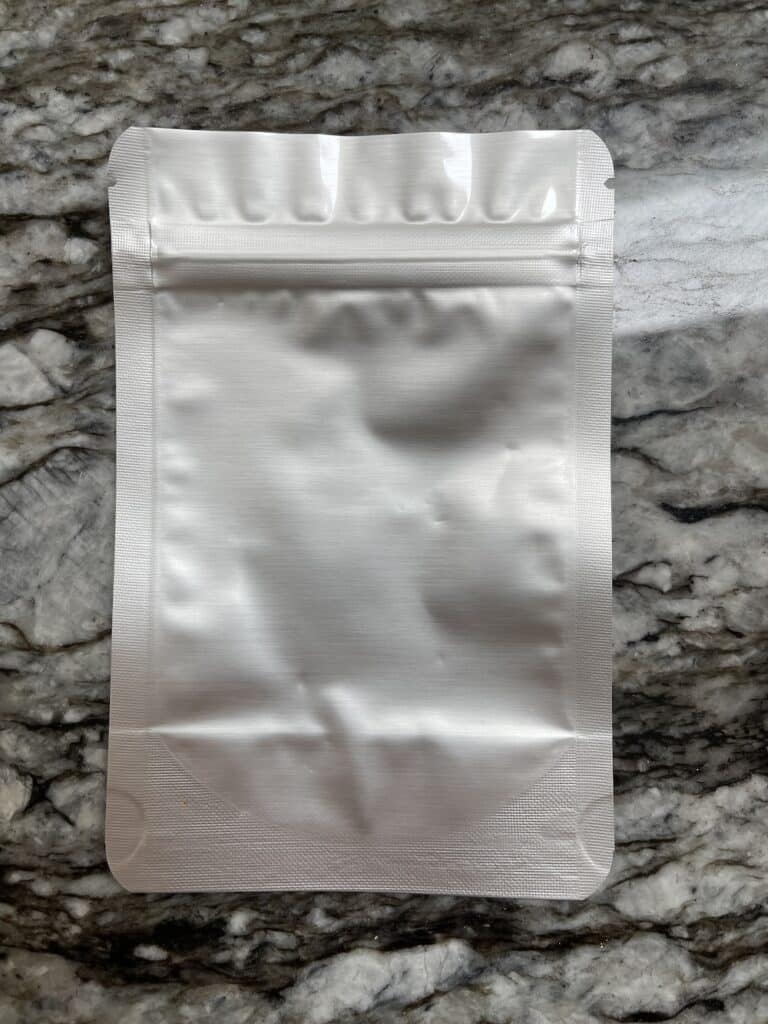
Choose a bag your household can reasonably empty after opening.
Large bags use less packaging material, but smaller portions protect the rest of the supply from repeated exposure to air and humidity.
Gussets and Zippers
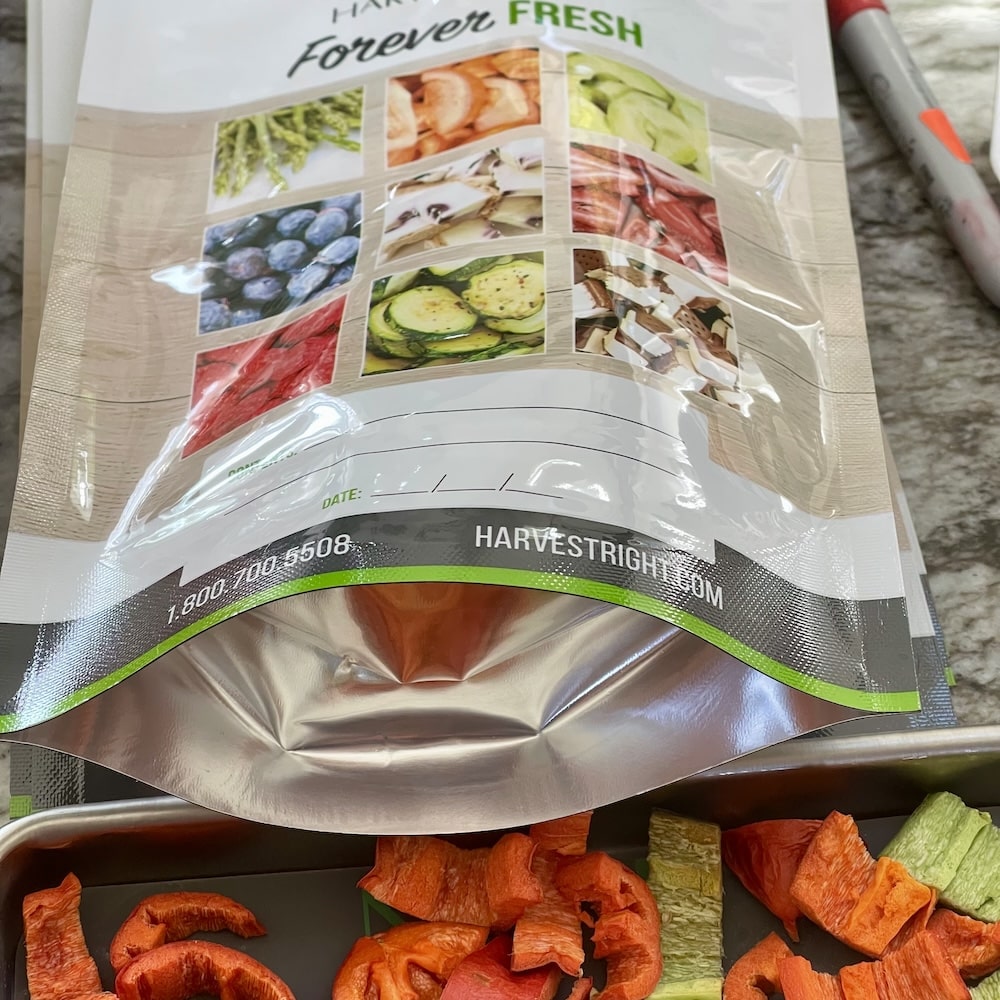
A gusseted bottom can help a pouch stand upright while being filled or used as a meal container. A zipper can help close the bag after opening.
These are convenience features. Neither replaces a proper heat seal.
I have had better results with sturdy bags from established food-storage suppliers than with some thin bargain assortments. Whatever brand you purchase, examine the bags for weak seams, pinholes and inconsistent construction before trusting them with valuable food.
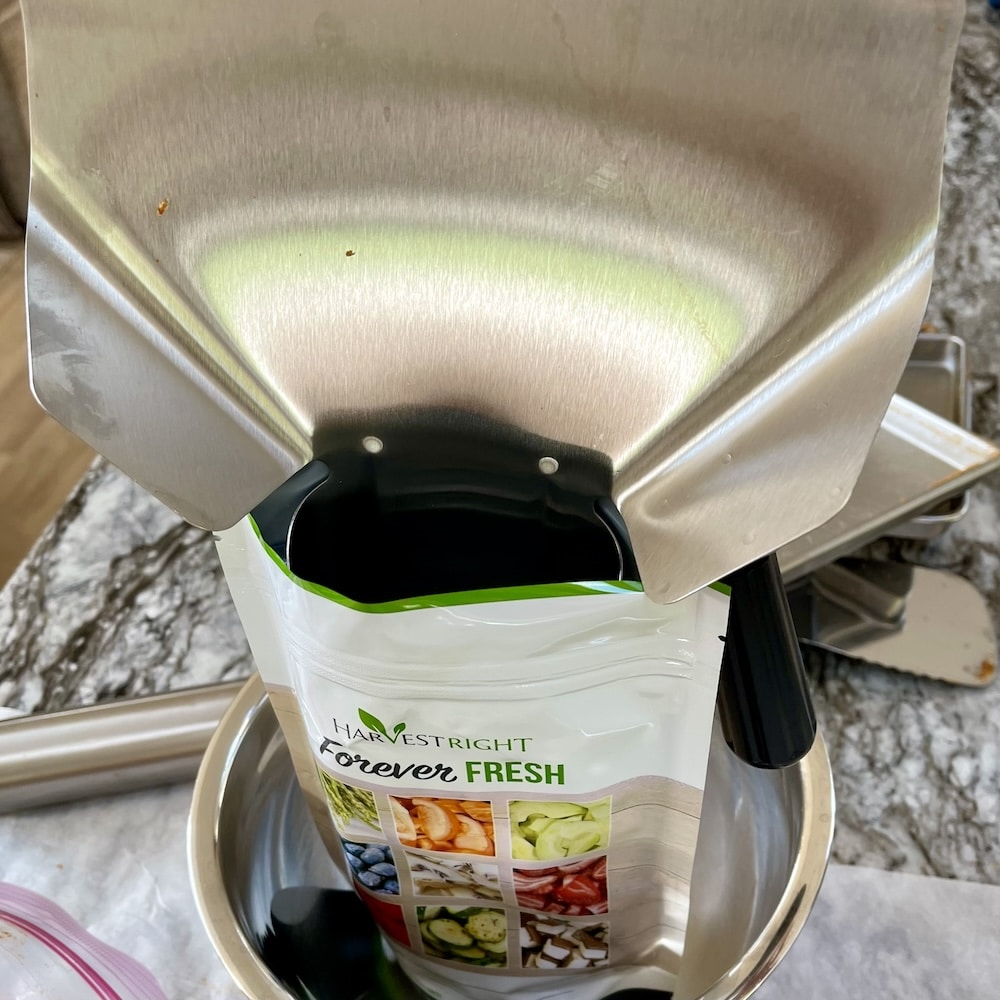
How to Package Food in Mylar Bags
Have the entire packaging station ready before you remove finished food from the freeze dryer. Freeze-dried food begins absorbing humidity as soon as it is exposed to room air.
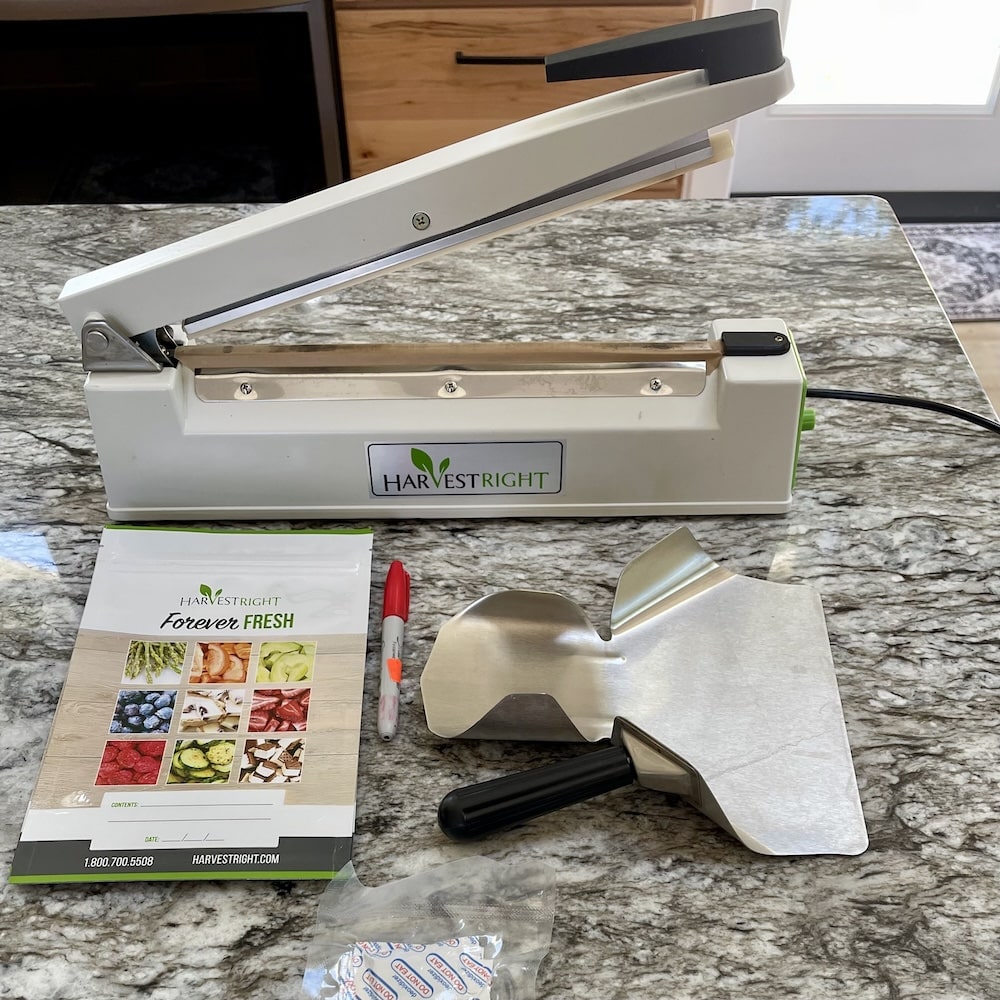
Set out:
- Clean, completely dry Mylar bags
- Your impulse sealer, iron or other compatible heat-sealing tool
- The correct food-safe oxygen absorbers, when appropriate
- A clean, dry scoop or funnel
- Labels and a permanent marker
- A clean, dry container for unused oxygen absorbers
- Your batch notes and rehydration information, when needed
Then follow this process.
1. Confirm That the Food Is Completely Dry
Check the thickest pieces and foods from several parts of the tray. Break dense pieces open.
If any portion feels cool, soft, gummy or damp, add more dry time.
Do not package questionable food for shelf storage.
2. Choose a Useful Portion Size
Package an amount you expect to use after opening.
Large bags save packaging material, but smaller bags often protect food better in real household use because the remaining supply stays sealed.
For prepared meals, record the serving size and the amount of water needed for rehydration before filling the bags.
3. Fill Without Contaminating the Seal Area
Use clean, dry utensils and leave enough empty bag above the food to make a flat, uninterrupted heat seal.
Powders and small crumbs can interfere with sealing. If food touches the inside of the sealing area, wipe that strip clean and dry before closing the bag.
Do not overfill. A bulging bag is difficult to lay flat and more likely to develop a poor seal or be punctured by hard food edges.
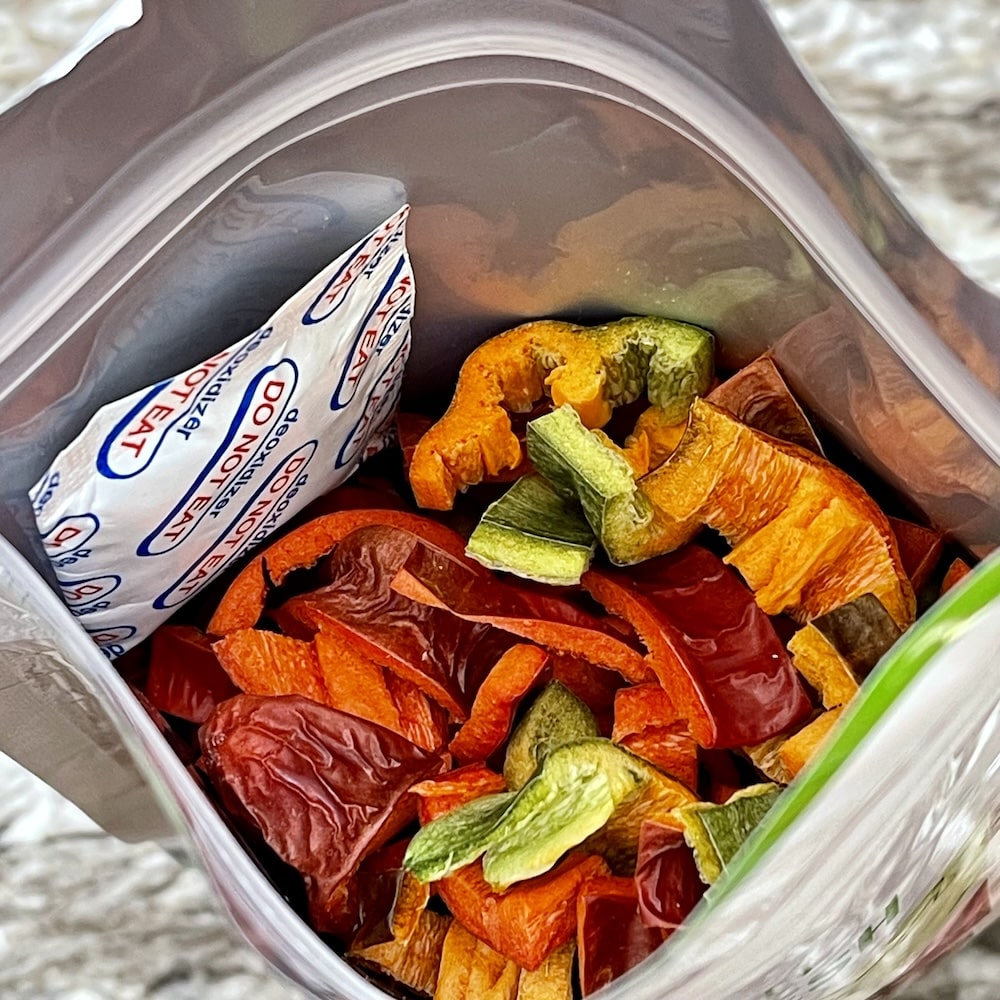
4. Add an Oxygen Absorber When Appropriate
Use only food-safe oxygen absorbers intended for the food and container size.
Follow the sizing directions supplied by the oxygen-absorber manufacturer rather than guessing from the outside dimensions of the bag.
Open the absorber package only when your filled bags are ready to seal. Work efficiently, and immediately return unused absorbers to an airtight container.
Read our complete guide to oxygen absorbers for freeze-dried food for selection, sizing, handling and storage details.
5. Press Out Excess Air
Gently press out excess air without crushing fragile food or pushing particles into the sealing area.
You do not need to remove every pocket of air. An oxygen absorber removes oxygen. It does not remove the nitrogen and other gases that make up most of ordinary air.
6. Heat Seal the Bag
Lay the top of the bag flat and make a straight, continuous seal across the full width.
An impulse sealer is convenient and consistent, but many compatible Mylar-style bags can also be sealed with a household iron or hair straightener.
Follow the bag manufacturer’s temperature and timing guidance. Test your equipment on an empty bag before packaging a full batch.
The zipper, when present, is useful after opening but is not enough for long-term storage. Heat seal the bag above the zipper.
Many home preservers add a second parallel seal above the first as inexpensive backup protection, provided the bag has enough sealing area.
7. Inspect the Seal
Look for wrinkles, food particles, gaps or narrow channels crossing the seal. Gently tug the sealed edges to make sure they do not separate.
An oxygen absorber may cause the bag to pull inward around the food, but not every properly sealed bag will look vacuum packed. Do not use the appearance of the bag as your only seal test.
If the seal is questionable, reseal the bag in a clean area above or below the failed seal, or transfer the food to a new bag.
8. Label for the Person Who Will Use the Food
At minimum, write:
- The food name
- The processing or packaging date
- The amount or number of servings
- Whether meat or eggs were packaged raw or cooked
- Rehydration or preparation directions when useful
- Any batch information you may need later
An unidentified powder in an opaque bag is not very useful two years from now.
9. Protect the Filled Bags in Storage
Store sealed packages in a cool, dry, dark place with relatively stable temperatures.
Mylar is a barrier package, but it is not armor. Hard food edges can puncture it, and rodents can chew through it.
For long-term storage, place filled bags in sturdy food-grade buckets or lidded totes and keep them off damp floors.
Periodically inspect the storage area for pests, punctures, failed seals or unexpected changes in the food.
If a package is damaged, the food has softened or clumped unexpectedly, or you suspect moisture entered, do not taste the food to decide whether it is safe.
Do Mylar Bags Need to Be Vacuum Sealed?
No. Mylar bags do not have to be vacuum sealed to work.
For many dry-food applications, you can press out the excess air, add an appropriately sized oxygen absorber and heat seal the bag. The absorber reduces the oxygen that remains inside the sealed package.
Some vacuum or chamber sealers can evacuate and seal compatible Mylar bags. Many ordinary external vacuum sealers depend on textured channels in their own specialty bags and may not draw air effectively from a smooth Mylar pouch.
Vacuum sealing can also crush delicate freeze-dried foods or pull sharp edges against the bag.
Treat vacuum sealing as an optional packaging method, not a requirement.
Oxygen Absorbers and Silica Gel Are Not the Same
These packets perform different jobs.
An oxygen absorber reduces the oxygen remaining inside suitable sealed packaging. It does not dry inadequately preserved food or remove all gases from the bag.
A food-safe silica gel desiccant captures a limited amount of moisture in appropriate applications. It cannot finish freeze drying food or make moist food safe.
Do not automatically add both packets to every bag.
Use only food-safe products and follow the directions for the particular packet and food. Some oxygen absorbers depend on a small amount of moisture to activate, so an unnecessary desiccant can work against the packaging plan.
Our guide to silica gel packets for food storage explains when a desiccant may be useful and when it is not needed.
How Long Does Food Last in Mylar Bags?
There is no single shelf-life number for food stored in Mylar bags.
Shelf life depends on:
- The food itself
- Its remaining moisture and water activity
- Fat content
- Sanitation and preparation before drying
- Packaging quality
- Oxygen exposure
- The integrity of the seal
- Storage temperature, humidity and light
Some commercially processed freeze-dried foods and low-fat dry staples are sold with 20- or 25-year shelf-life claims.
Those products are made and packaged under controlled conditions and may be supported by product-specific testing. We should not automatically apply those numbers to every food made in a home freeze dryer.
Current university Extension guidance says properly freeze-dried foods can remain stable for many years in appropriate airtight, moisture-proof packaging under cool, dark and dry conditions. However, food quality and nutrients still change during storage.
My practical approach is to package food correctly, date every batch, store it well and use a first-in, first-out rotation system.
Learn how each food performs in storage, use it while it is still good and replace it with a newer batch.
The success of home food storage is not measured by how long a package can remain untouched. It is measured by whether the food stays safe, retains acceptable quality and eventually becomes useful food for your household.
Can Mylar Bags Be Reused?
Sometimes, but inspect them carefully.
A bag may be reusable when it:
- Held a clean, completely dry food
- Has no grease or lingering odor
- Has no punctures or damaged seams
- Shows no signs of delamination
- Still has enough material to make a new dependable heat seal
For valuable food intended for extended storage, I generally prefer a new bag.
Reused bags are better suited to shorter-term dry storage when their condition is easy to monitor.
Mylar Bags Are One Part of a Complete Storage System
Good Mylar bags earn their place in a home-preservation pantry. They are lightweight, space efficient and very effective at protecting properly dried food from moisture, oxygen and light.
But they are not necessary for every food or every storage goal.
Use jars and smaller airtight containers for food moving through the working pantry. Use high-barrier Mylar-style bags when the food and intended storage period justify them.
Whatever container you choose, begin with safely prepared, adequately dry food. Make a dependable seal, label it clearly, protect the package and rotate the food back into your kitchen.
That is how food storage becomes a useful household system rather than a collection of forgotten bags. Read our guide on Long and Short Term freeze dried food Storage
Frequently Asked Questions About Mylar Bags for Food Storage
What thickness of Mylar bag is best for food storage?
For freeze-dried food intended for longer storage, sturdy opaque bags in approximately the 5- to 7-mil range or heavier are commonly recommended.
Check whether the manufacturer reports thickness per wall or for the complete bag. Consider barrier construction and seal quality as well as thickness.
Is the zipper on a Mylar bag airtight enough for long-term storage?
No. A zipper is convenient after opening, but food intended for long-term storage should be heat sealed above the zipper. The heat seal provides the dependable closure.
Do Mylar bags have to shrink tightly around the food?
No. Oxygen absorbers remove oxygen, not all of the nitrogen and other gases inside the package. A properly sealed bag may draw inward, but it may not look like a commercial vacuum package.
Does every Mylar bag need an oxygen absorber?
No. It depends on the food and intended storage period. Oxygen removal is not recommended or necessary for every dry food. For example, it is not recommended for long-term sugar storage. Use an oxygen absorber only with appropriately dry foods and follow reliable food-specific and manufacturer guidance. Read more on O2 absorbers here.
Can I use Mylar bags with clear windows?
Windowed bags can be convenient and fun gifts bags for candy, snacks and shorter-term products.
For deeper storage, I prefer fully opaque high-barrier bags because they protect the entire package from light and avoid a potentially weaker barrier section.
Can I seal Mylar bags with a household iron?
Many heat-sealable Mylar-style bags can be sealed with an iron or hair straightener.
Follow the bag manufacturer’s directions and test the seal before relying on it. An impulse sealer is easier to use consistently when you package food frequently.
Can an oxygen absorber rescue food that may not be completely dry?
No.
Return questionable food to the freeze dryer or use another safe storage method. An oxygen absorber protects appropriately dry food. It does not make incompletely dried food shelf stable.
Further Reading For Freeze Drying:
- Read Our complete Post On Freeze Drying Equipment
- Freeze Drying Food Safety: How to Preserve Food Safely at Home
- Freeze Dried Food Storage Tips for Short and Long Term Storage
- How Does Freeze Drying Work?
Research Sources
- Utah State University Extension: Packaging Foods
- Utah State University Extension: Can I Freeze-Dry That? A Practical Guide to Safe and Effective Freeze-Drying
- Penn State Extension: Let’s Preserve—Freeze-Drying
- U.S. Food and Drug Administration: Water Activity in Foods
Follow Us:
We enjoy meeting you on our social networks. Follow us on Facebook, Pinterest, Instagram . Tag us with your pictures of our recipes and comment on how it went for you. We would love to see what you do with them.
We often like, comment and share your posts of our recipes on our daily Instagram stories.
Ask questions and rate the recipe in the comments section below. Please share what you did with this recipe. We are always looking for more and better ways to make homemade food. Other cooks love your ideas!
Recent Posts:
