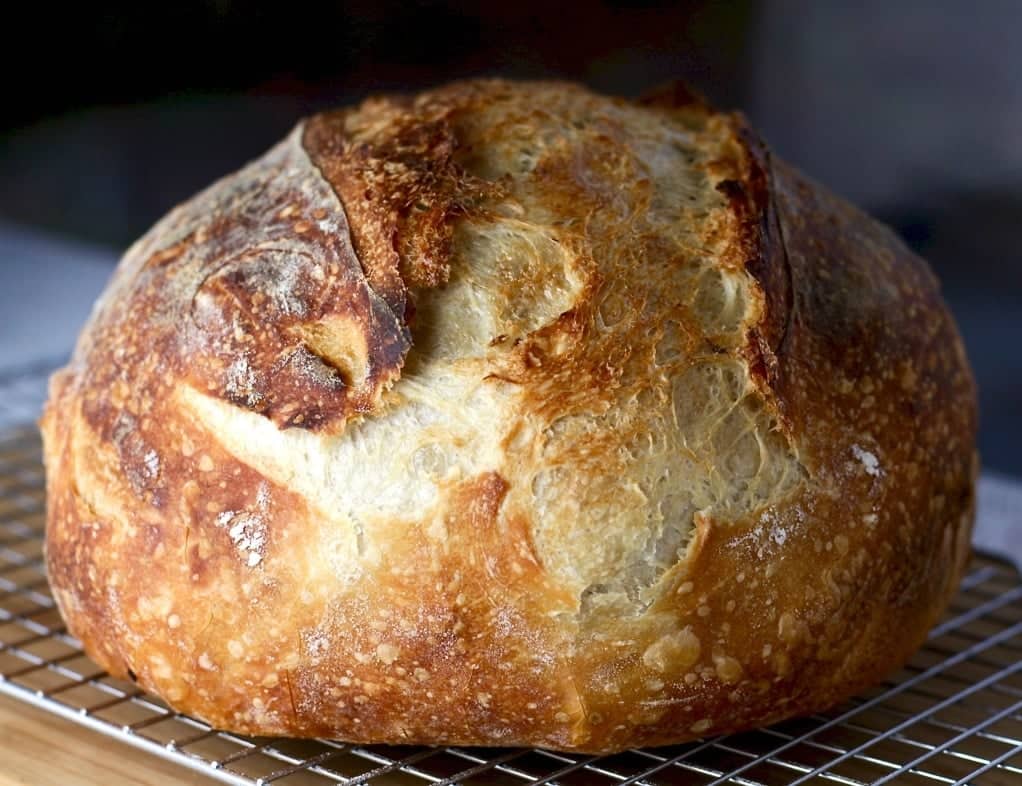
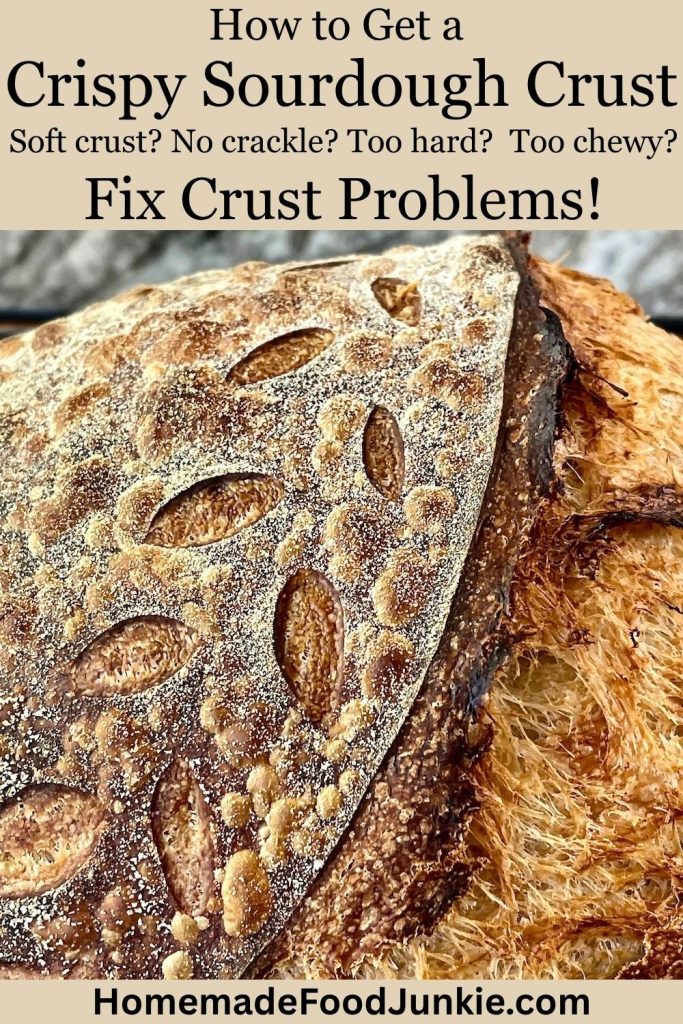
Does your sourdough look beautiful coming out of the oven—but the crust turns soft, feels too thick, chewy or never crackles? Learn how to get crispy sourdough crust in this guide.
The real issue is not just the crust. It’s how moisture is balanced between the crumb and the crust during and after baking. Once you understand that, crust problems become simple to diagnose and fix.
Most bakers rely on internal temperature, the “thump” test, or fixed bake times to determine when the loaf is baked. But those signals don’t tell the whole story.
You can hit all of them and have problems in your crust. This guide helps you find and fix imperfections in your actual baking process, and in your particular oven, that will improve your sourdough crust, and to some degree, even your bread crumb.
Your bread is not done when it reaches temperature…
This guide covers the final stage of baking. To learn how to get a crispy sourdough crust you must understand what is in this guide.
It covers:
-how the crust dries and sets.
-how to know when the crust is correctly baked
-why you don’t get bread music
-why your crust goes soft after baking
-why your sourdough crust is too hard, thick or chewy
-how to take control of your oven and your baking method to correct these problems
For earlier steps in the bread making process, see:
How Sourdough Baking Works (Applies to Any Method)
Before fixing crust problems, it helps to understand what your oven is actually doing during the bake—because every crust outcome is created in these stages.
No matter how you bake—Dutch oven or open bake with steam—the same core processes apply. The difference is only in how you create steam and airflow.
The Three Phases of a Sourdough Bake
Every sourdough loaf goes through the same progression:
Early steam allows expansion
Mid-bake heat sets structure
Final airflow dries the crust
NOTE:Most crust problems happen in the final drying stage, not at the beginning of the bake. But they all play a part.
How This Looks in Practice
Covered Baking (Dutch Oven)
A Dutch oven creates steam by trapping moisture released from the dough.
Strong, consistent steam
Reliable oven spring
Requires a proper drying phase at the end
Open Baking with Steam
Open baking uses added steam (tray, lava rocks, etc.) to create the same early conditions.
More control over steam and airflow
Requires active steam management early
Often dries more easily at the end
NOTE: Different baking methods all use same bake phases.
Example: Dutch Oven Method (Step-by-Step)
Phase 1: Steam (Covered)
Bake at 475–500°F for 20–25 minutes (no convection).
The enclosed environment traps steam, keeping the surface flexible and delaying crust formation so the loaf can fully expand.
NOTE: This phase is what allows strong oven spring.
Phase 2: Structure + Color
Remove the lid (or dissipate steam) and reduce temperature to about 450°F.
the surface firms up
color develops through the Maillard reaction
the loaf structure stabilizes
NOTE: This stage determines how thick or thin your crust becomes.
Phase 3: Drying (Critical Step)
Remove the loaf from the Dutch oven and place it directly on the oven rack or baking stone. Bake for 5–10 minutes.
Airflow reaches the entire loaf and begins drying the crust fully. If you use a combo pan with low or open sides this may not be necessary
Optional: use convection at this stage to increase airflow.
NOTE: This is where most crust problems are either fixed—or created.
Phase 4: Final Drying
Turn the oven off, crack the door, and leave the loaf inside for 5–10 minutes.
This allows remaining moisture to escape gradually without over-browning the crust.
NOTE: This step helps stabilize the crust and often produces that crackling “bread music.”
Know Your Oven
Why Your Oven Changes Your Results
Even at the same temperature, ovens behave differently.
some trap moisture
some vent aggressively
some brown too fast
This is where your steam and oven spring in sourdough baking process becomes important.
Key Point: Learn your oven and adjust your baking method—not your recipe.
How to Adjust Baking Methods:
Extend bake time if crust softens
Lower temperature if crust hardens too quickly
Use convection only at the end
Add a short drying phase with the door cracked
Why Sourdough Doesn’t Crackle (“Bread Music”)
That crackling sound you hear when you remove your bread loaf to the cooling rack signals that the crust has dried and moisture is escaping properly.
Lean rustic sourdough bread crusts are rigid and crack when pressed or cooled after baking. This is why it is called bread music.
Cracks form as crust cools. This makes bread music.
You should hear crackling right after you remove your loaves from the oven. When the crust hits the cool air it will crack as hot air escapes into the room.
If you don’t hear it:
the crust is still too moist
the crumb may not be fully set
However, Bread music is a confirmation signal—not the only test. Some crusts will not crackle when cooling. Enriched doughs with oils and other additions baked in may not crackle like lean rustic artisan breads.
We will go through all the clues to recognizing a well baked sourdough bread. This is how to get a crispy sourdough crust. Otherwise, your bread may ultimately disappoint you.
Soft and enriched breads are not as likely to crack and sing when cooling due to additions in the dough.
Sourdough Crust Problems (Quick Diagnostic Guide)
There are several kinds of problems that beset sourdough crusts. We go through them here. Most are simple to fix by adjusting your baking methods. Some problems will point the way to deeper issues in your bread making that need further attention.
Sourdough lean breads made with flour, water and salt should crackle as they cool. But if, as you remove the bread from the oven, the bread is quiet, that is a tell. Your lovely crust can go from crisp to wrinkled, dimpled or it may just lose its crispness as it cools. You will have a soft crust. And often a damp crumb.
For example, look at the gallery below. All the same loaf. It came out of the oven with a crisp crust and looked well baked. (my temperature was correct. I ignored the gummy crumb on the probe) as the loaf cooled you can see in the middle picture the dimples caused by escaping moisture. And the last shot, the crumb has damp areas where moisture was trapped.
just out of the oven crust is perfect.IF, as the loaf cools, dimples form. This is your tell. not baked long enoughcrumb is not classically gummy, but still damp in spots. Loaf not completely baked. Crumb collapses. See the crust separation?
This happens because the trapped moisture in your bread is evaporating through the crust. Some of the moisture inevitably will soften, even collapse areas of your crumb and crust on its way out. And some moisture will not escape. This is how you get a damp crumb and soft crust.
Of course, you may never see this evidence in your loaf if you have only a small amount of moisture trapped. Then the soft crust may be your only evidence that drying did not complete.
How to Fix It:
There are several ways to dry your crust during baking. Don’t trust your loaf to be dry when the timer goes off. Even after you are at the correct internal temperature.
If your internal temperature probe comes out gummy, or the thump is not hollow, the loaf crumb is not done. Here is what to do about it.
Extend the uncovered bake by 5–10 minutes
Remove the loaf from the Dutch oven for the final stage. Set it on your baking rack to finish after Lid off.
Add a drying phase: oven off, door cracked, 5–10 minutes
Cool completely on a wire rack
Ultimately, if your sourdough crust is not crispy it means you have a baking problem, not a dough problem. Apply these ideas to your baking to eliminate soft, dimpling, and collapsing crust and wet crumb sections in your bread.
Sourdough Crust Too Hard
A hard crust is rigid and difficult to slice. When you overdo the temperature or drying stage this can happen.
Cause
Too much drying
Too much airflow or convection
Temperature too high after lid removal
How To Fix It
Shorten the drying phase slightly
Lower temperature after removing the lid
Use convection only at the end
As the baker, you will have to play around with these ideas to see what works best for you, your recipes and your oven.
Sourdough Crust Too Thick
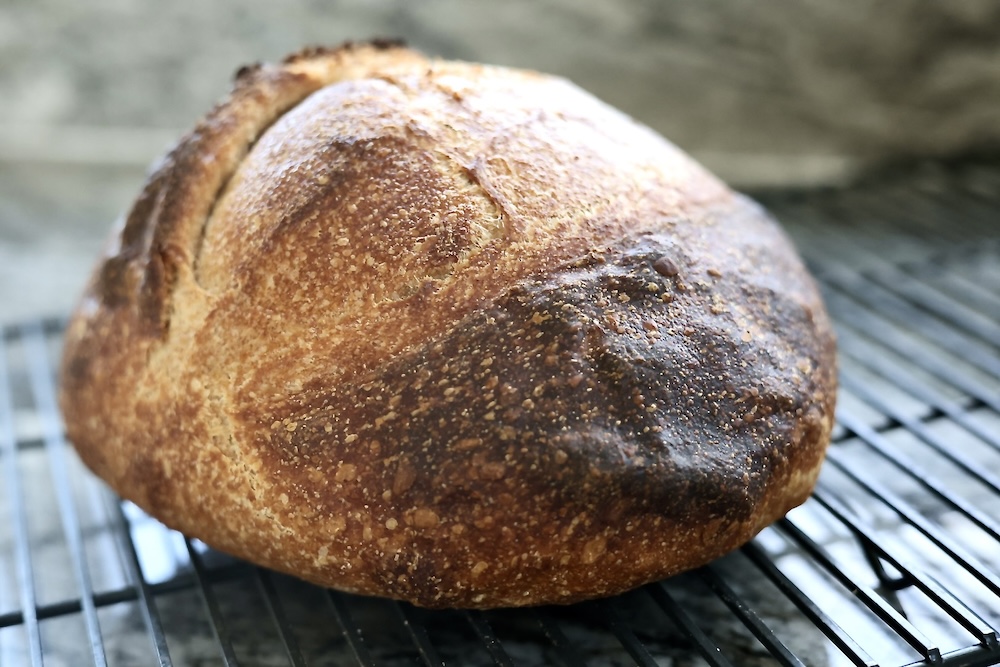
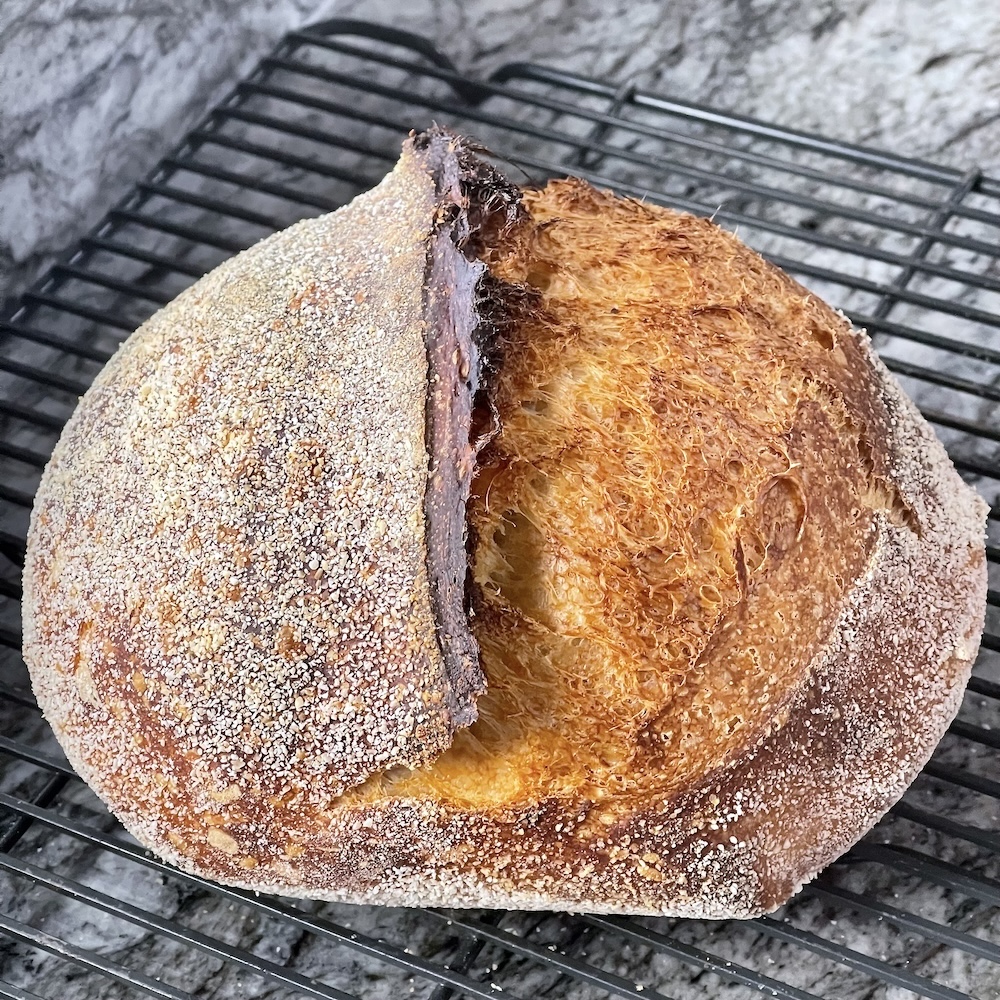
Thick, hard crust. As it cooled it hardened. This was a very difficult loaf to cut and enjoy.
A thick crust forms when the outer layer sets too early. This bread had a tender open crumb but the crust was difficult to cut. It was thick and hard and very chewy. This happened in my early baking days, before I had a proper dutch oven and did not understand how steam works.
A chewy crust bends instead of cracking. This makes chewing a real challenge. The crust may be delicious but very hard to actually eat.
Cause
Moisture is still present in crust.
How To Fix It
Extend uncovered bake
Improve airflow
Add final drying phase
Sourdough Crust Quick Fix Table
Problem
Cause
Fix
Soft crust after cooling
Moist crumb releasing steam
Bake longer + add drying phase
Not crispy
Crust not fully dried
Extend uncovered bake
No crackling
Crust not set
Add final oven dry (door cracked)
Too hard
Over-dried crust
Shorten final bake or lower temp
Too thick
Crust set too early
Improve early steam
Too chewy
Moisture trapped
Increase airflow + drying time
Dimpling
Moisture moving outward
Bake until crumb fully set
Gummy probe
Underbaked crumb
Keep baking (ignore temp)
Pale crust
Not enough heat/time
Bake longer uncovered
Uneven color
Uneven oven heat
Rotate loaf
Use this as a quick guide—but always confirm your bake with a clean probe, firm crust, and proper drying.
Crust Signals: Is Your Loaf Fully Baked?
Do not rely on one signal. Learning how to get crispy sourdough crust relies on learning all these clues.
Use these together:
Clean probe (most important) No gummy residue on thermometer
Firm crust Not soft or flexible
Hollow Thump-dense thud tells you its not done
Lighter feel Indicates moisture loss
Deep color Even browning
Optional: bread music Confirms proper moisture movement
If your thermometer shows sticky residue—even at 212°F—your loaf is not fully baked Add 5 minutes onto your timer, check again. When the probe is clean, the crumb is set. Now open the oven door with the oven off. Let it sit in there for 5 to 10 minutes to completely dry. This is how you get a reliable crispy sourdough crust.
A properly baked sourdough crust gives you clear visual and physical signals. We listed these above but here we will cover each in more detail.
Learning to recognize these “tells” helps you confirm your bake—without relying only on time or temperature, or thump.
Sourdough Spelt Blend Bread
Crust Color And Caramelization
A well-baked loaf should have a rich golden to deep brown crust—not pale or dull.
This color develops through the Maillard reaction, where heat causes sugars and proteins in the dough to react and create both color and flavor.
What it means:
the crust has had enough heat and time to develop properly
flavor has fully developed
Important: Color alone does not guarantee the loaf is fully baked. Always confirm with other signals.
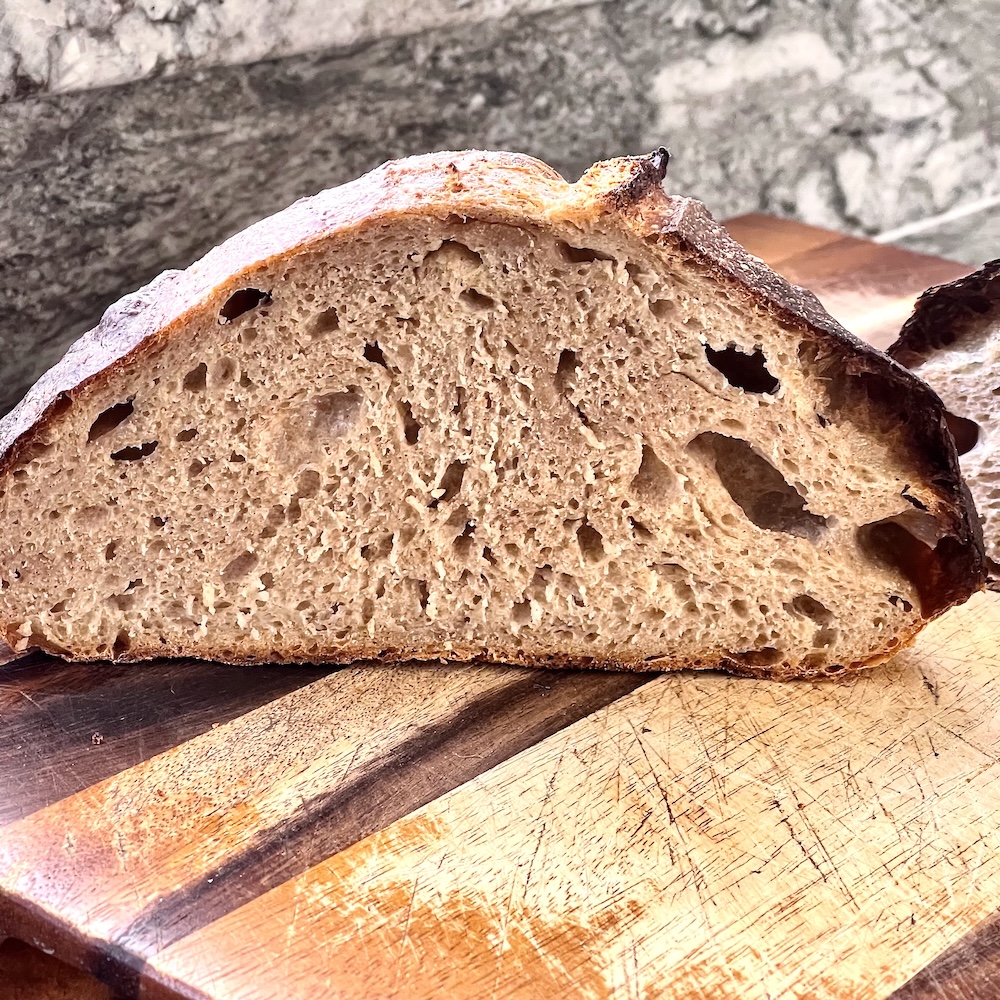
This crust over dried somewhat and got a bit thick and hard. But the crust had bread music, cut well and the crumb was excellent.
Cracks And Crackling
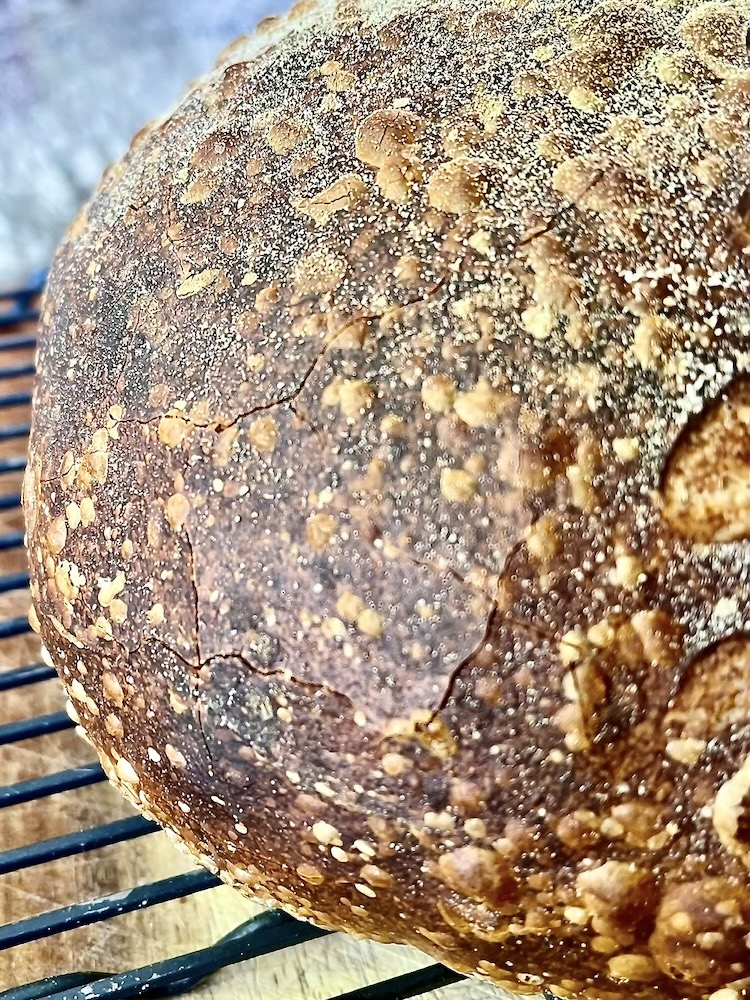
Look for small cracks forming across the crust as the loaf cools.
These happen when:
the crust dries
steam escapes from the interior
the surface contracts slightly
What it means:
the crust has dried and set properly
moisture is moving out of the loaf as expected
You may hear soft crackling sounds after baking.
What it means:
the crust is fully set
the moisture gradient between crumb and crust is correct
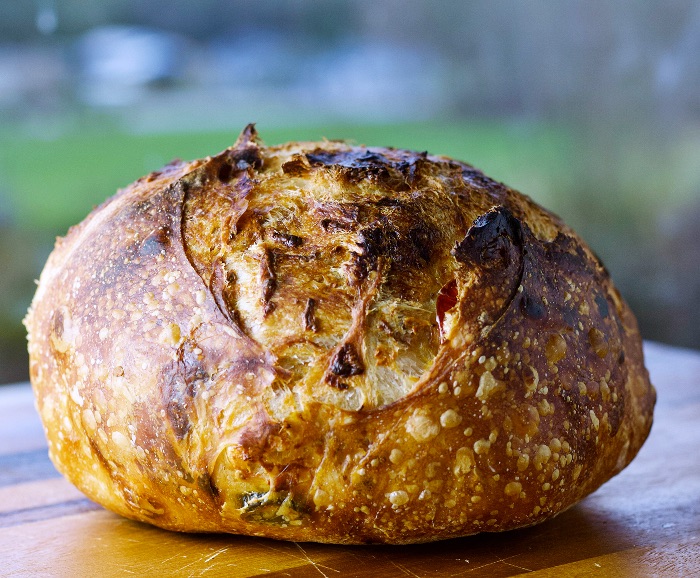
Blisters appear as small bubbles or raised spots on the crust and are a hallmark of a well-executed sourdough bake.
They form when fermentation, surface moisture, and steam early in the bake all align.
Cold proofing often encourages blistering because it allows moisture and sugars to concentrate at the dough’s surface after shaping. This creates ideal conditions for small gas pockets to expand just under the crust during baking.
Cold bulk fermentation can support this process indirectly by improving overall fermentation, but it does not create the same surface conditions.
What Blisters mean:
fermentation was well developed
steam delayed early crust setting
the crust dried and set properly
Blisters are not required for a good loaf—but when present, they are a strong visual signal that your process is working well.
Slight Shine on Expansion Points
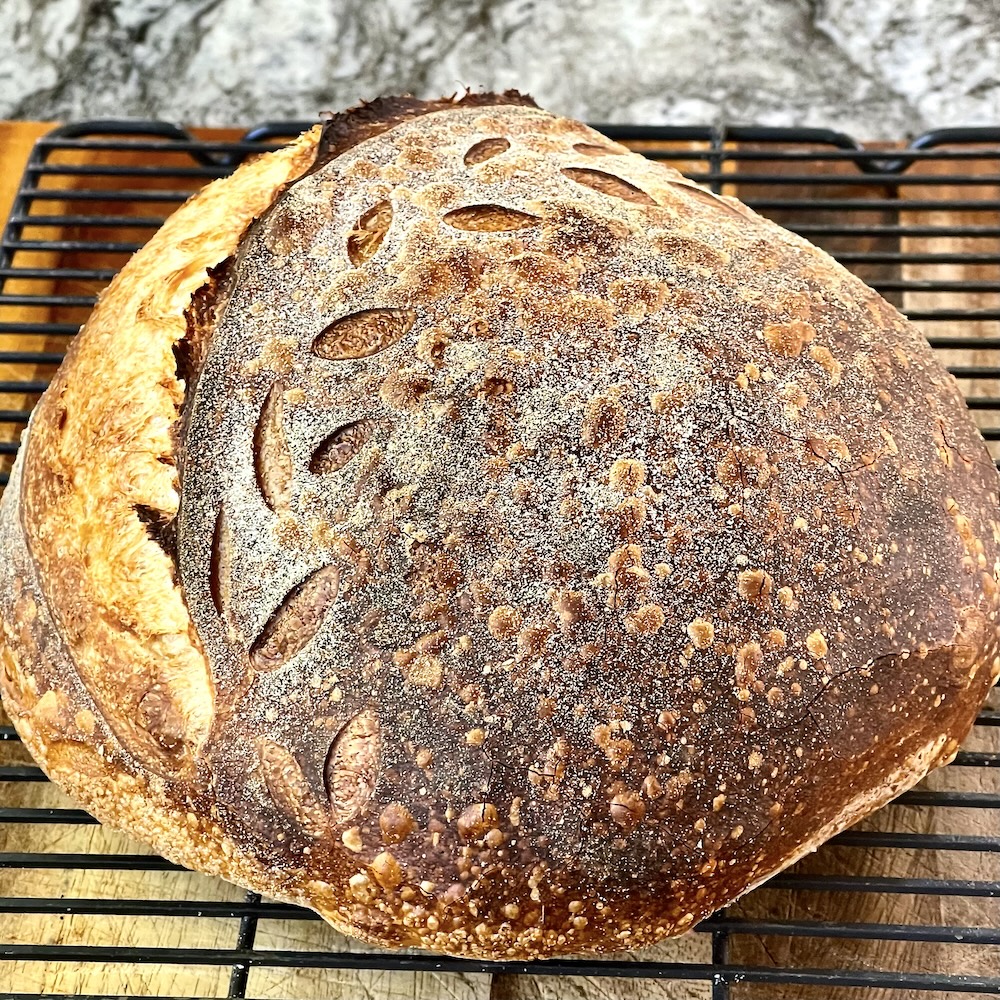
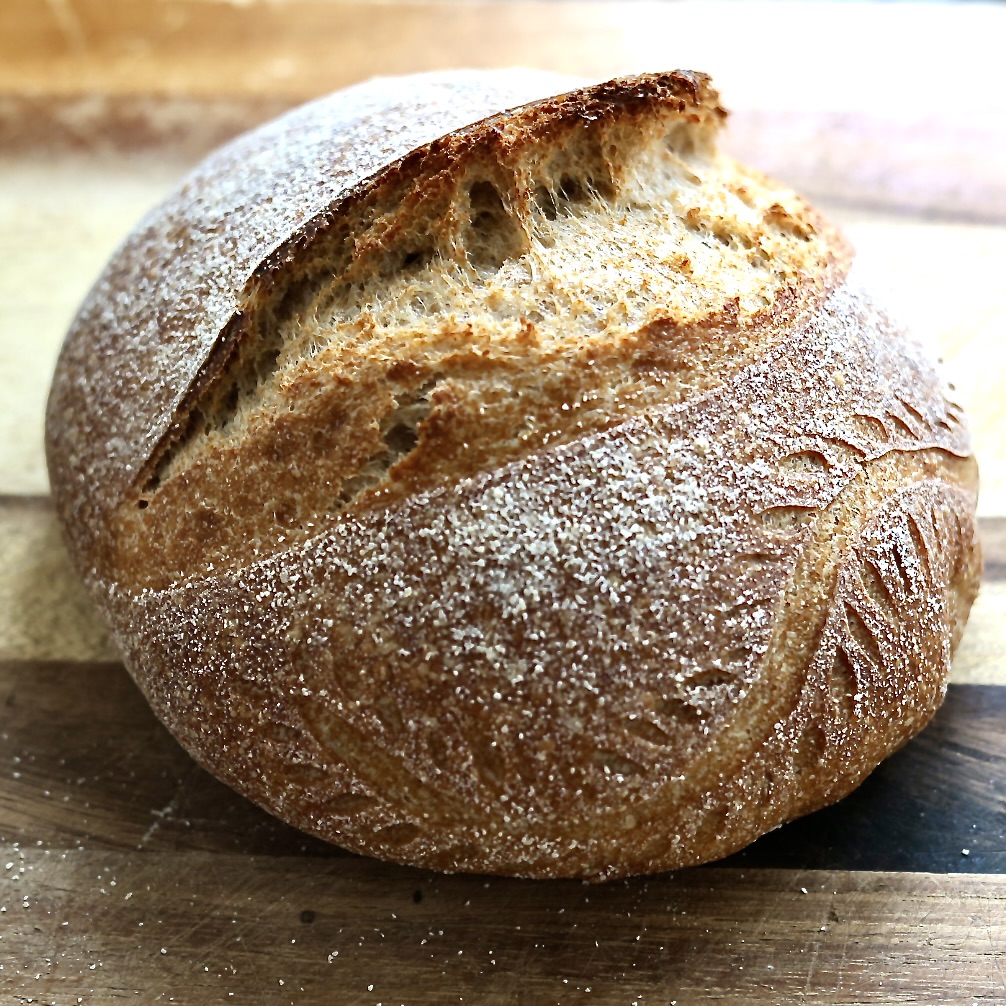
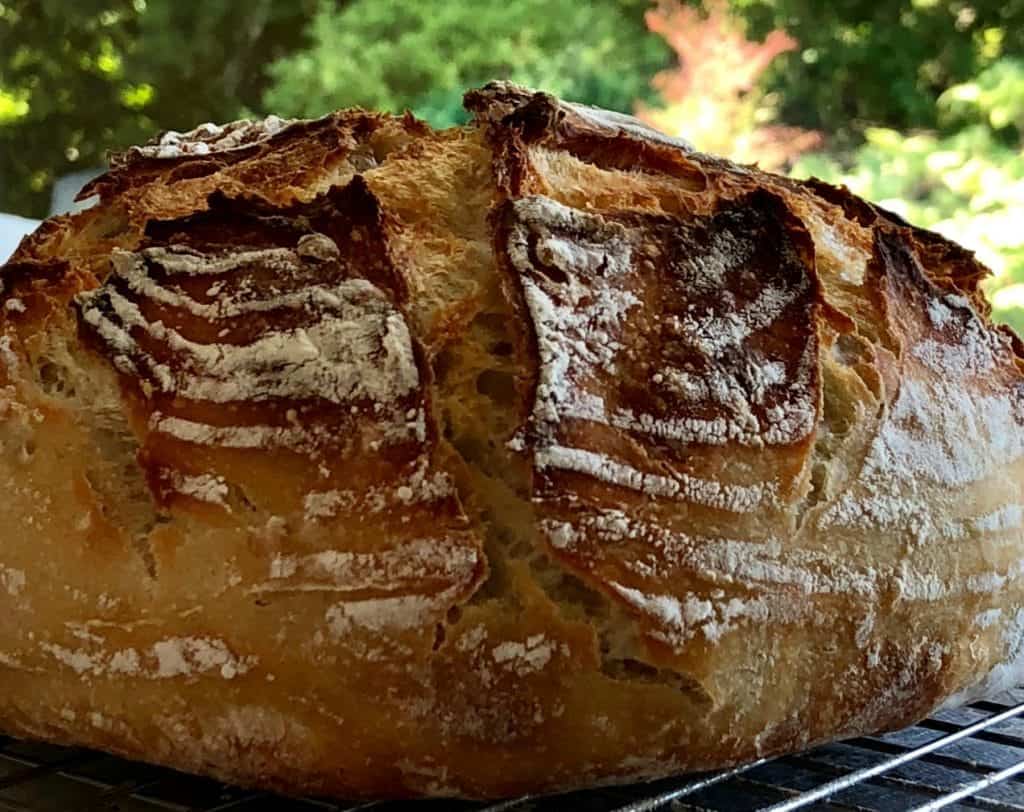
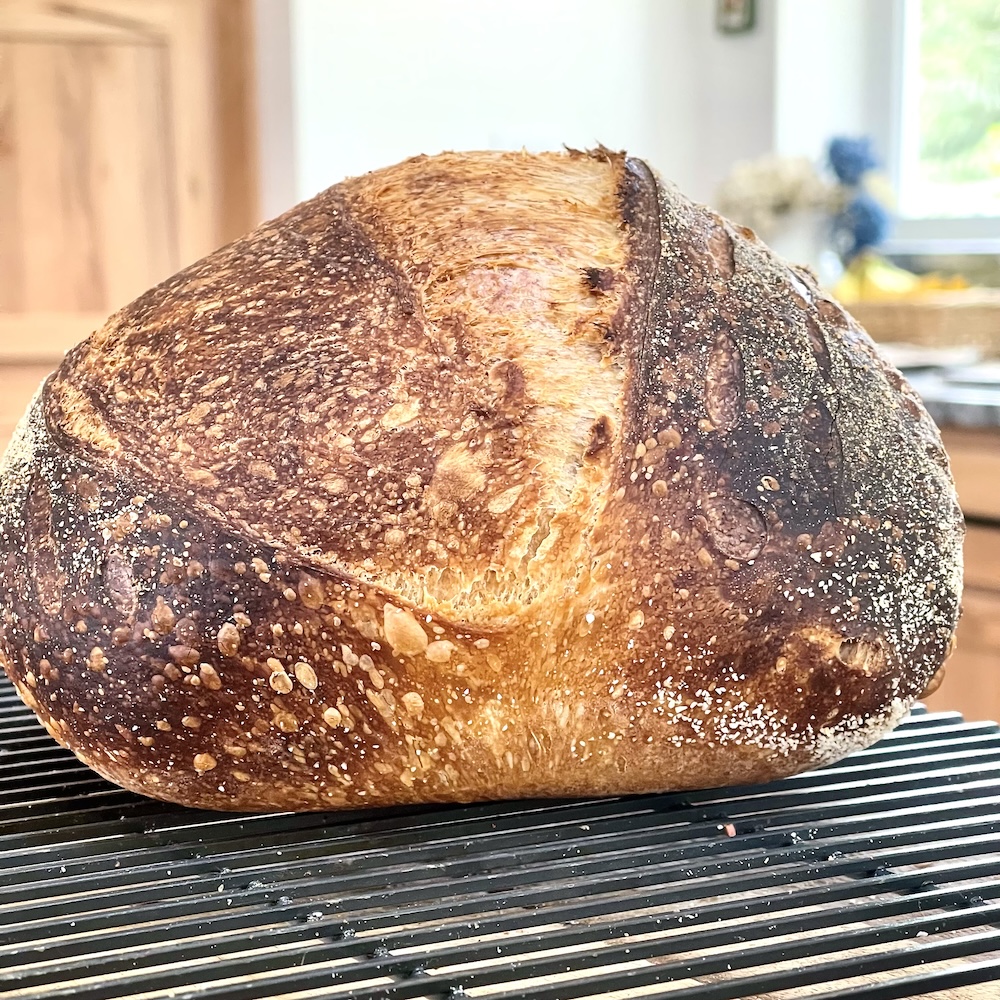
Look at the scoring lines or natural expansion cracks. You may see a slight sheen or gloss in these areas. Or the whole crust may shine as our loaf pictured above.
What it means:
the crust stretched properly during oven spring
starches gelatinized before fully drying
the transition from steam to dry heat was well timed
Firmness And Weight
Gently press the crust.
It should feel:
firm and set
not soft or rubbery
not excessively thick or rigid
What it means:
the crust has dried sufficiently
the structure is stable
Light, Dry Feel:
When you lift the loaf, it should feel lighter than expected. If you’re baking two loaves they may feel different in weight if not exactly the same dough weight or if very different crumb development happened. but both should be much lighter than when the bake began.
What it means:
moisture has been baked out effectively
the loaf has finished drying
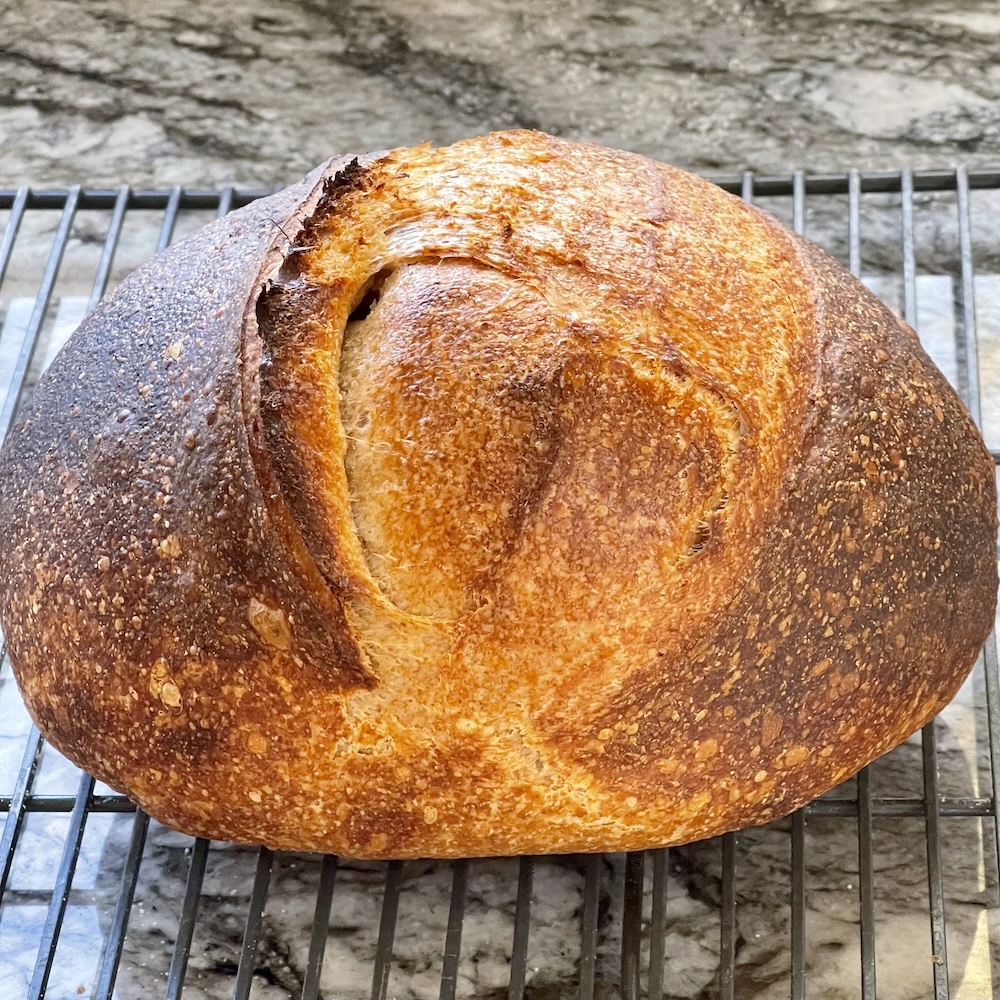
You can see the slight shine and caramelization on the score line, and the ear.
What These Signals Mean Together
No single sign tells the whole story.
A properly baked crust usually shows several of these at once:
This is a tricky one. You can have perfectly baked sourdough with a crispy crust that is dreadfully difficult to cut. The crust may not be the problem.
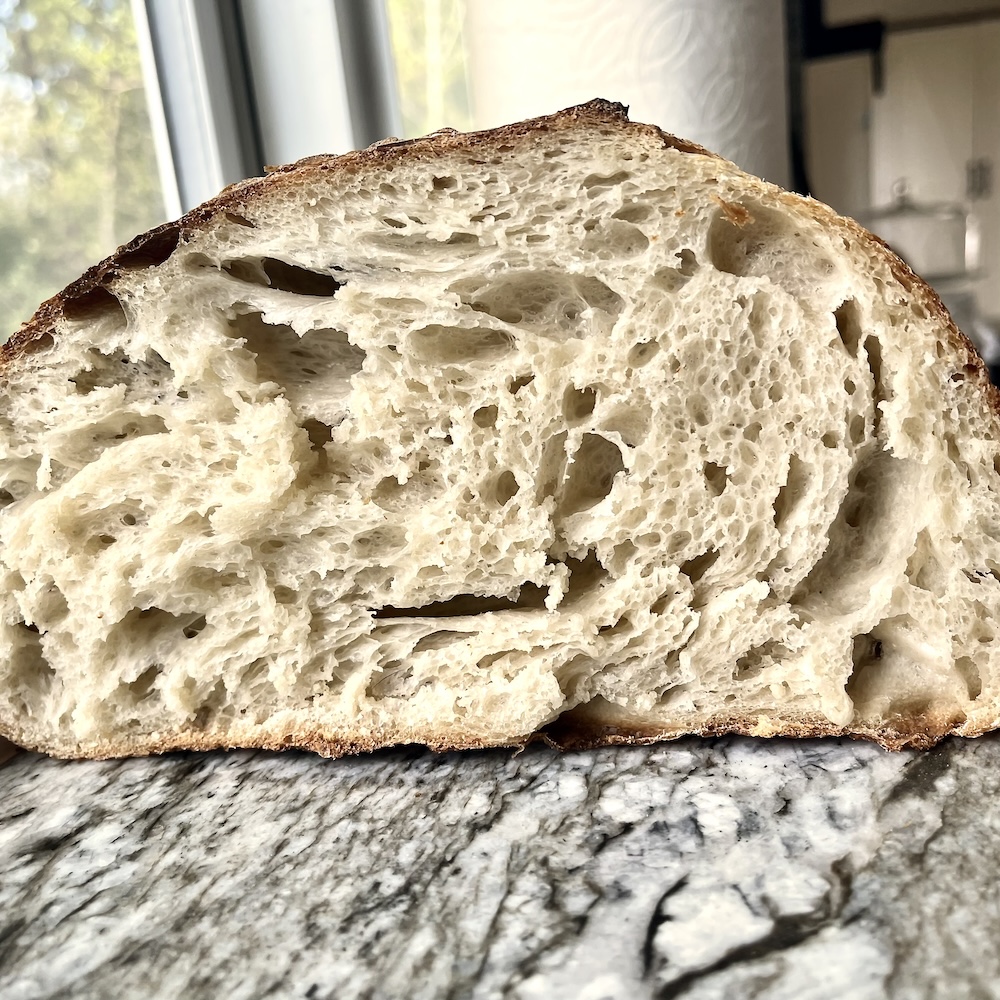
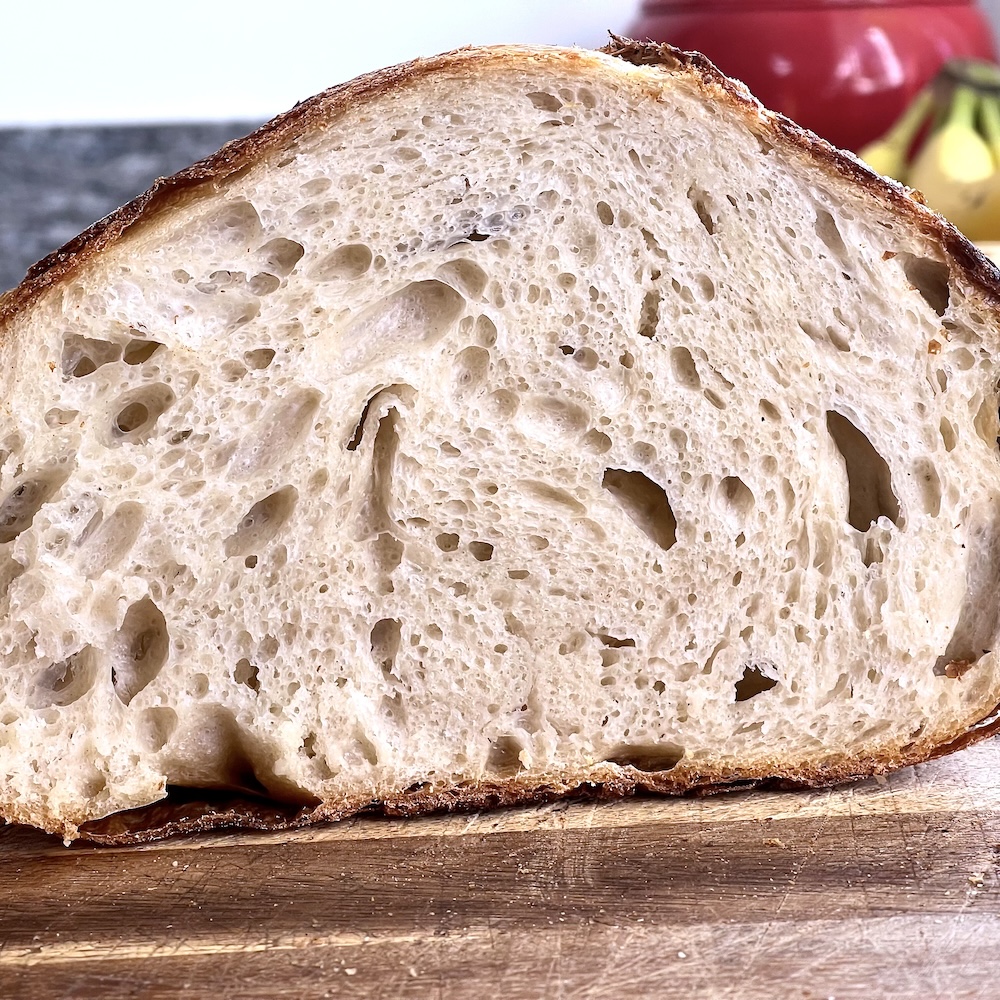
When you have a wonderful rigid artisan crust that is properly baked with an airy open crumb, the knife has to be extremely sharp to cut it without the crumb collapsing. That crispy sourdough crust can push back on the knife. too much pressure on the knife compresses the open, creamy, airy crumb. The crumb will tear rather than cut as pictured below.
Perfectly baked crispy artisan crust.A creamy open crumb. Delicious but very difficult to cut.
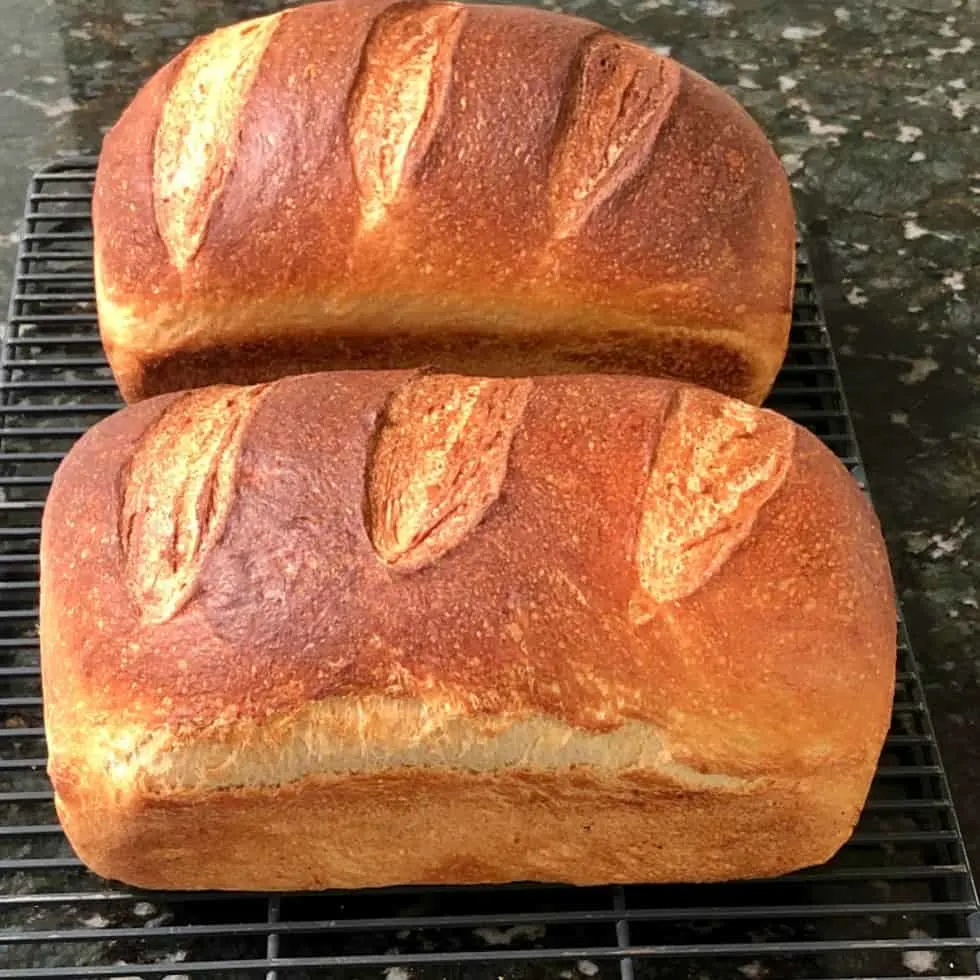
When your crumb is dryer and more structured, the crust cuts like a dream. This loaf, same dough as above, shaped for sandwiches, with a more structured crumb that cut easily with the same knife.
The second loaf also had more drying time. Moisture in the crust and crumb can cause a crust to be resistant to the knife. And damp crumb cannot cut. It gets stuck on the knife.
crumb structure is denser and less open than the loaf crumb shown above. This makes a difference in your baking method.One dough with two very different crumbs.
Reasons you can follow the same recipe and get very different baked outcomes.
Using more folds, or doing coils vs. stretch and folds so the dough changes
shaping the dough differently, for example, may create two different dough structures from the same basic recipe.
different dough proof temperatures and timings can impact the dough structure and consequently, how your sourdough bakes.
Changing the amount of water in your recipe, accidentally or on purpose will change how your loaf bakes.
Changing the flours in your recipe will have a decided impact on your final bake.
When you create a more tightly structured dough:
It holds more gas
It retains more moisture
It has stronger structure
This is why dough structure matters when you bake.
As you master different techniques in dough structure building, proofing correctly, scoring techniques, and steam baking your dough will bake differently. Learn how to get crispy sourdough crust in all your recipes and variations. Take control of your bake!
Sourdough crust problems aren’t random—and they’re not complicated once you understand what to look for.
Soft or chewy crust is from too much moisture left in the loaf
Hard or thick crust – too much drying or heat imbalance
No crackling – the crust didn’t fully set
Dimpling after cooling – the crumb wasn’t fully finished. Moisture escaping after cooling softened the crust.
NOTE: Your bread is not done when it reaches temperature—it’s done when the crumb is set and moisture movement has stabilized.Crust problems don’t come from the crust alone—they come from how moisture is balanced between the crumb and the crust at the end of the bake.
How you score your bread is important too. The loaf opens to release moisture much better if properly scored.
FAQ
Why is my sourdough crust soft after baking? Your crust softens because moisture from the crumb moves outward as the bread cools. This usually means the loaf needed more drying time at the end of the bake.
Why doesn’t my sourdough bread crackle? Crackling only happens when the crust fully dries and contracts. If the loaf retains too much moisture, the crust stays soft and silent.
Why is my sourdough crust too hard? A hard crust comes from over-drying or too much heat during the final phase of baking. Reducing bake time or temperature slightly can help.
Why is my sourdough crust too thick? A thick crust often forms when the outer layer sets too early due to high heat or insufficient steam during the covered phase.
Why is my sourdough crust chewy? A chewy crust means moisture is still present. Extending the uncovered bake and adding a drying phase will improve crispness.
What temperature should sourdough be when done? Most sourdough breads finish between 208–212°F, but temperature alone isn’t enough. Always check for a fully set crumb and dry crust.
Continue Learning
Sourdough works as a complete system, from fermentation through baking.
To keep improving your results, explore the full process: