How to Control Sourdough Crumb (Open vs Soft Sandwich Style)
As an Amazon Associate and member of other affiliate programs we earn a small commission from qualifying purchases through our affiliate link. For more information read our Entire Affiliate Disclosure.
Learning how to control sourdough crumb is a major step forward for any baker. If your bread feels unpredictable—sometimes open, sometimes dense, or sometimes a frustrating mix of both—this guide will help you understand the main levers that shape crumb structure.
Yes, you can influence whether your bread turns out open, balanced, or soft and even. Many bakers assume crumb comes down to hydration or fermentation. These matter—but once they’re in place, handling becomes the main control point.
If you want to understand what your crumb is telling you so you can analyze your bakes, read our guide on how to read sourdough crumb structure. Here, we focus on how to change it. These two posts form your complete sourdough crumb troubleshooting guide.
For a complete collection of sourdough guides and recipes, visit our Sourdough Baking Hub. It contains ALL our sourdough guides and links to our sourdough recipe pages. Find out more about sourdough baking helps by reading our Sourdough Troubleshooting Guide.
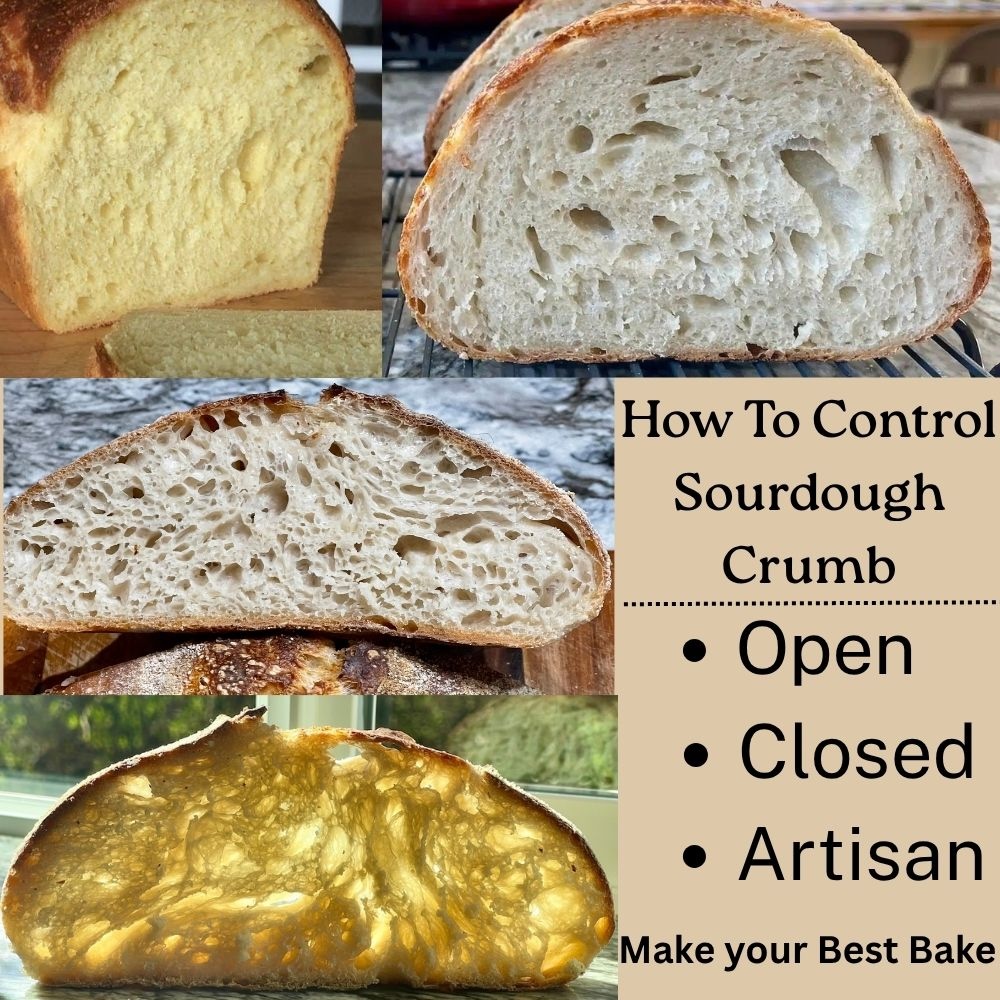
In this guide, we’ll show you how handling alone can change your crumb—from open and irregular to soft and even—using the exact same dough. Further down this post, I did a three-way crumb demonstration bake. I show you how the handling impacted the sourdough crumb structure in each of the loaves.
Related Concepts:
Sourdough crumb is controlled by several key factors: All of these factors are part of the big picture of controlling your sourdough crumb.
Why Learning to Control Sourdough Crumb Matters
Most bakers learn to make good sourdough—but many stop there.
If you’re baking Tartine-style loaves with an open, rustic crumb, you may already be happy with your bread and not care one bit about the crumb. The crumb will be uncontrolled. This means the crumb will run wild, with unpredictable results. That’s why it’s a good recipe for beginner bakers.
But over time, many bakers want to establish a consistent, more controlled crumb. This post will help with that. You may feel frustrated with:
- inconsistent results
- some loaves open, others dense or uneven
- sandwiches that fall apart or leak fillings through large holes
This is where crumb control matters. It allows you to move beyond “whatever happened” and start baking for a specific result.
What Crumb Control Gives You as a Baker
When you understand how to control crumb, you can:
- Bake an open, rustic loaf when you want a light, airy bread
- Create a balanced crumb that works for everyday use
- Build a tight, even crumb for sandwiches and toast
- Avoid frustrating results like big holes with dense sections
- Adjust your bread based on how you plan to use it
In other words, you move from reacting to your bread to designing it
The Real Shift: From Passive to Intentional Baking
Many beginner sourdough methods—like Tartine—teach you to:
- preserve gas
- handle gently
- Let the dough “do its thing”
That approach works beautifully. it’s the Beginner Artisan Sourdough Bread Recipe approach. And many bakers never want to make anything else.
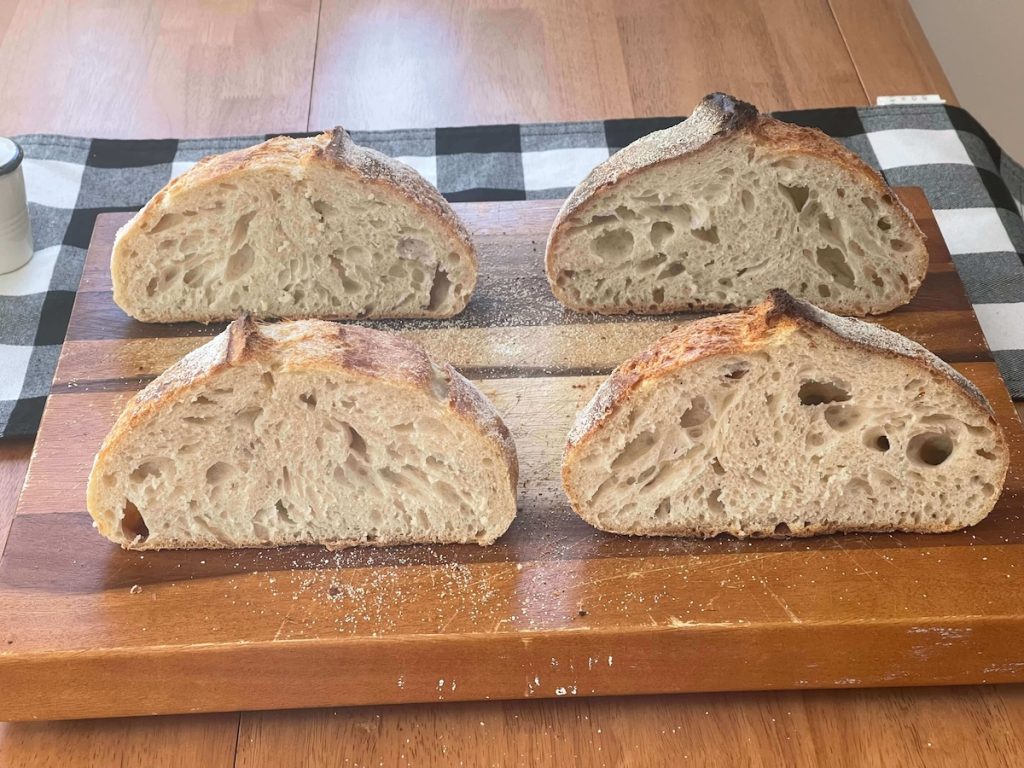
But crumb control is a different skill: You learn to manage gas, not just protect it
That means:
- redistributing large bubbles
- organizing structure
- shaping with purpose
This doesn’t replace the Tartine method—it builds on it.
You Don’t Have to Change Your Style—Just Expand It
Learning how to control sourdough crumb structure gives you flexibility:
- Bake wild and open when you want
- Bake structured and even when you prefer
That flexibility is what separates: a good baker from a consistent, intentional baker
What Is Sourdough Crumb Structure?
Crumb refers to the interior of your bread—the pattern of holes formed by gas during fermentation.

A well-structured, more honeycomb-style crumb.
Crumb structure depends on three things:
- gas (fermentation)
- structure (gluten strength)
- distribution (handling)
Open Crumb vs Sandwich Crumb
Open crumb
- larger, more irregular holes
- lighter, airier feel
- better for rustic loaves, toast, dipping
Sandwich crumb
- better for spreads, sandwiches, toast
- smaller, more even holes
- softer, more sliceable structure
Our Milk and Honey Sourdough Bread show you a soft, sandwich crumb. You need to degass the dough for this softer, denser crumb.
Great for sandwiches and toast. Our soft sourdough sandwich bread recipe calls for degassing with a rolling pin to get the gas bubbles really tiny and force the gas to distribute evenly.
Some bakers just use their fingers to dapple out the large bubbles to get aggressive when shaping the dough and squeeze large gas bubbles out then. Any sourdough flour blend can give you a good sandwich crumb with properly structured dough handling.
Learn to control sourdough crumb to make sandwich loaves
- smaller, evenly distributed holes
- soft, sliceable structure
- better for spreads and sandwiches
Neither is better—they’re just different outcomes. Whole grain blend flours often produce a tighter sandwich crumb without any degassing.
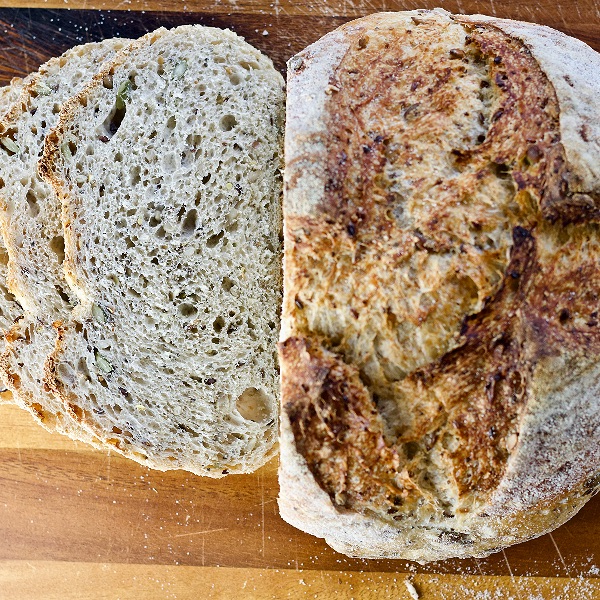
How To Control Sourdough Crumb (What Actually Controls Your Crumb)
Several factors influence your final crumb—but not all of them matter equally at every stage.
Fermentation
Fermentation creates the gas. There are both cold proof and cold bulk methods of fermenting. And also counter temperature bulk. All these methods do different things to the dough structure and consequently, the crumb. Whatever bulking method you choose…
If proofing is off, you’ll see:
- dense crumb (underproofed)
- weak structure or collapse (overproofed)
Once fermentation is correct, the dough has the gas and structure needed to form a good crumb.
Hydration
Higher hydration can encourage a more open crumb—but it does not guarantee one.
If gas is poorly distributed, even high-hydration dough can produce large holes alongside dense areas.
Read more on Understanding Hydration in Sourdough.
The Real Control Point: Handling
Once fermentation and structure are in place, dough handling becomes the main variable.
Handling determines how gas is distributed—and that defines your crumb.
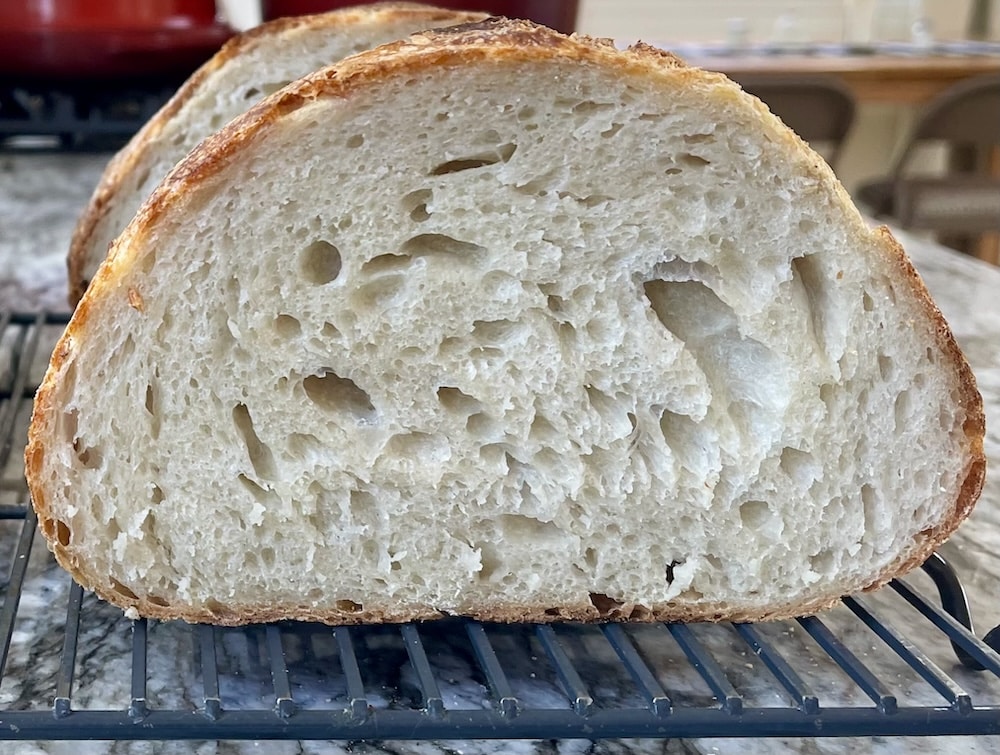
78% hydration Sourdough Crusty Jalapeño Cheese Bread with a decently balanced, more closed rustic artisan crumb, perfect for sandwiches.
The Most Common Crumb Problems
This is one of the most frustrating results in sourdough baking.
You’ll see:
- large, dramatic holes
- dense or gummy sections nearby
The bread may look open at first glance, but the texture is uneven—chewy in some areas, dense in others, and difficult to use for sandwiches.
This crumb shows large holes with dense, gummy sections—an uneven and impractical result.
Why This Happens
This is a gas distribution problem.
During shaping:
- large bubbles expand in one area
- other areas lack the structure or gas to open
- the result is uneven expansion and compressed crumb
Even with good fermentation, poor gas distribution or weak dough structure will create this pattern.
The Fix: Control the Gas, Don’t Just Preserve It
You are not deflating the dough—you are editing the gas structure.
Once fermentation and structure are correct, shaping becomes the step where you:
- preserve gas
- redistribute large pockets
- organize the crumb
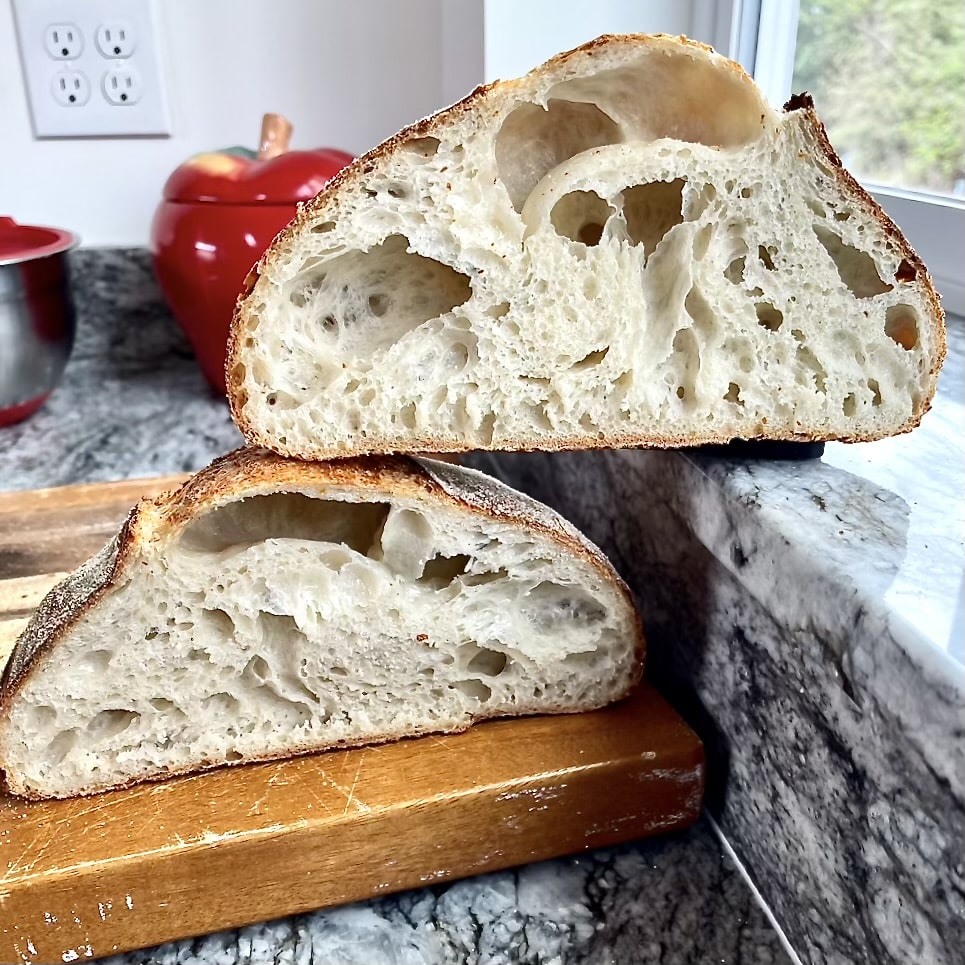
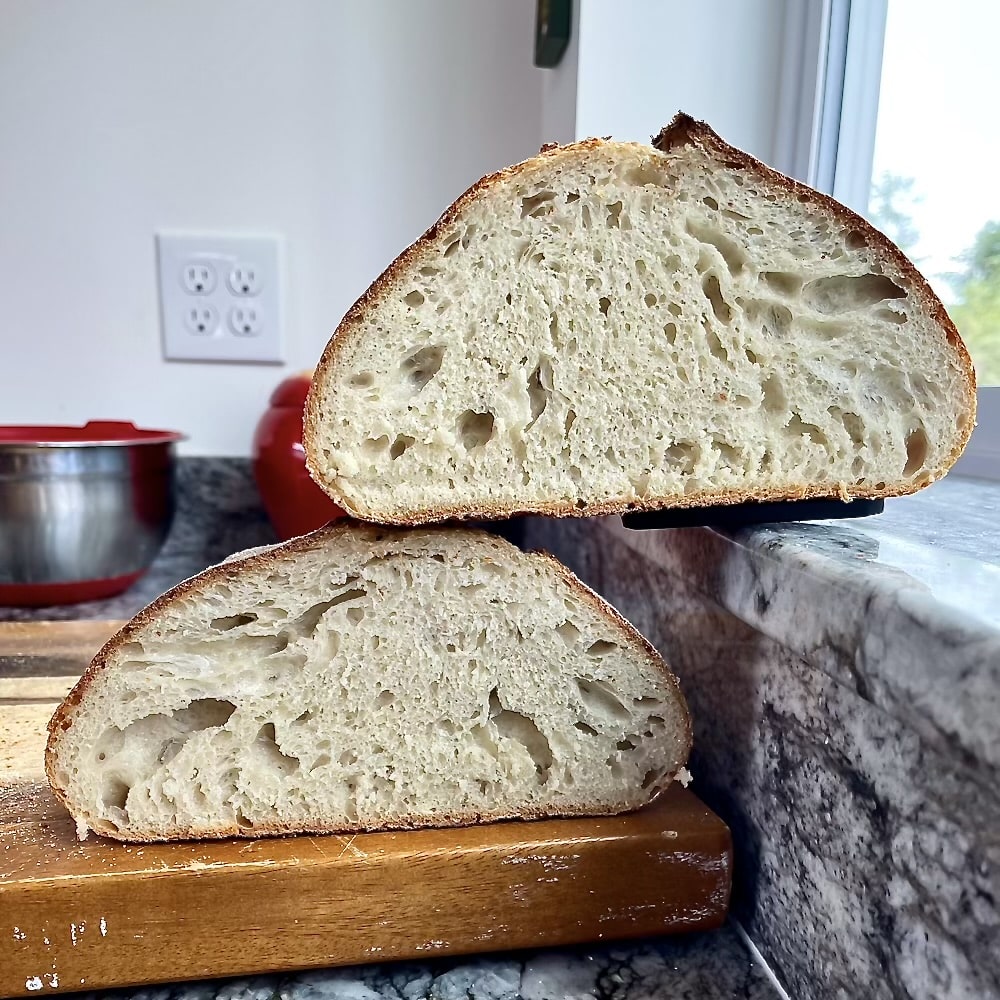
This was a single 2 loaf bake from the same dough. Only difference was the shaping. Loaf on left uncontrolled and loaf on right more assertively shaped with better tension.
Our sourdough shaping guide has tips on How to control sourdough crumb. The shaping guide will show you with pictures some basic dough handling to help learn how to shape with purpose.
How Handling Changes Crumb
Gentle Handling (Preserving Gas)
- keeps most bubbles intact
- creates large, irregular holes
- best for open artisan crumb
Selective Degassing (Redistributing Gas)
- breaks up oversized bubbles
- spreads gas more evenly
- best for balanced or sandwich-style crumb
Over-Handling or Full Degassing
- removes too much gas
- creates a tight or dense crumb
- useful only when a closed crumb is intentional
This is the clearest way to see crumb control in action: the same dough, three different handling choices, three different crumbs.
Real Example: Same Dough, Three Different Crumbs
These loaves were made from the same dough.
Everything else—hydration, flour, and fermentation—remained the same.
- 75% hydration
- same fermentation
- same bread flour
The only difference is how the dough was handled during shaping.
You know what you’re looking for in your crumb. Think of the following section as your clues to getting there.
Loaf 1 – Minimal Handling (Most Open)
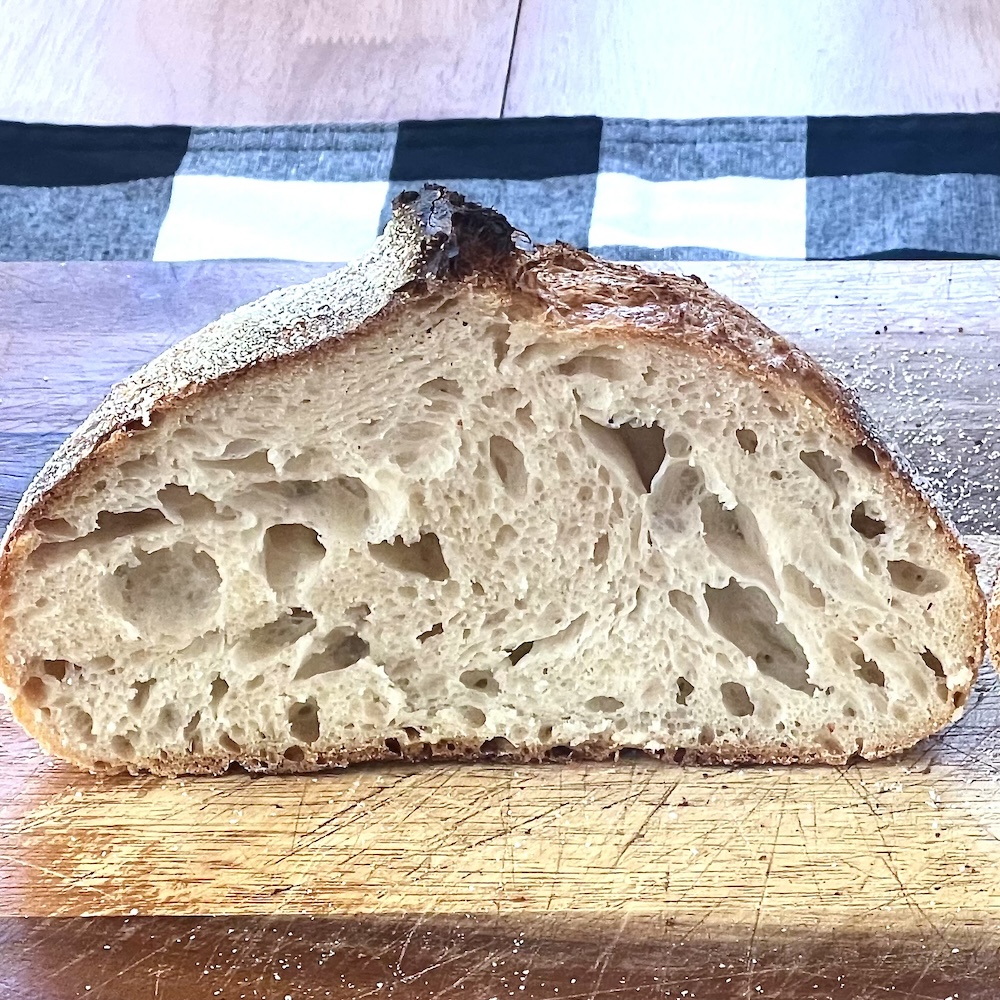
This is the handling style we use for our Beginner Artisan Bread (Tartine style). The dough is shaped very gently, with as little compression as possible. Rather than tightening it firmly into a boule, the dough is lightly pulled into shape so the gas stays intact.
What this creates:
- gas mostly preserved
- large, dramatic holes
- slightly uneven distribution
When you preserve most of the gas, you get the wild, open crumb typical of rustic artisan sourdough.
How to get this style of crumb:
- build structure early with folds
- handle the dough gently throughout bulk and shaping
- avoid squeezing out gas during pre-shape and final shape
- shape only as much as needed to form the loaf
This approach gives you an open, irregular crumb in the Tartine style.
Loaf 2 – Balanced Handling (More Even, Open Crumb)
This is the middle ground—an open crumb that is more controlled and evenly distributed.
What this creates:
- some larger bubbles, but redistributed
- open crumb with more consistency
- a balance of structure and openness
The alveoli are spread fairly evenly throughout the loaf, with a mix of small, medium, and a few larger holes.
To achieve this, shaping is more intentional. You preserve most of the gas, but gently redistribute larger pockets so the crumb opens more evenly.
This Rosemary Garlic loaf is another example, showing how handling influences both gas pocket size and distribution.
This is the “sweet spot” for many bakers—open, but practical. With practice, you can define what balanced crumb means for your style.
Loaf 3 – More Structured Handling (Most Controlled)
This style uses more deliberate handling to create a tighter, more uniform crumb. Some degassing is needed—but done gently with your hands, not aggressively or with tools.
Rather than removing all the gas, you’re redistributing it—pressing out large pockets and spreading the remaining gas evenly through the dough.
Shaping is firmer here, building strong surface tension and organizing the structure.
What this creates:
- more evenly distributed gas
- smaller, more uniform holes
- a stable, consistent crumb
This tighter structure is ideal for sandwiches and toast, where clean slices and even texture matter.
Side-by-Side Comparison
| Hole size | Large, irregular | Medium, balanced | Small, uniform |
| Distribution | Uneven | Even | Very even |
| Structure | Open but variable | Strong + open | Strong + tight |
| Best use | Artisan bread | Everyday loaf | Sandwich bread |
How to Control Sourdough Crumb:
In Summary: These are your major levers controlling how your crumb forms.
- fermentation creates gas
- structure holds it
- handling distributes it
Here are some ways to use and adjust these variables in your dough to control your crumb outcome more completely.
How to Get Open Crumb (Without Dense Areas)
To create an open crumb that still has good structure:
- ferment fully (but not excessively)
- build strength early with folds or coils
- handle gently during shaping to preserve gas
- avoid aggressive tightening or squeezing
Most important: only preserve gas if your structure can support it.
How to Get Sandwich Crumb (Without Density)
You don’t need enriched dough to achieve a soft, even crumb—lean dough works just as well with proper handling.
To create a tighter, more uniform crumb:
- press out only the largest bubbles
- avoid flattening the dough
- fold and tighten to organize structure
Think: redistribute, don’t destroy
The Sweet Spot: Selective Degassing
This is the key skill that bridges open and even crumb.
Before shaping:
- identify large surface bubbles
- gently press only those areas
- leave the rest of the dough intact
This turns an uneven, wild crumb into a more balanced, even structure.
a well-balanced crumb with a nice oven spring and moist, springy, sliceable crumb .
Frequently Asked Questions
Can I get open crumb just by increasing hydration?
No. Higher hydration can encourage openness, but it does not control crumb on its own. Gas distribution during shaping is just as important.
Why do I get big holes and dense areas in the same loaf?
This is usually a gas distribution issue.
Large bubbles were not redistributed during shaping, leaving some areas open and others dense.
How do I make my sourdough better for sandwiches?
Focus on selective degassing during shaping.
Press out large bubbles and tighten the dough slightly to create a more even, sliceable crumb.
Will more fermentation fix my crumb?
Not always. Once fermentation is correct, handling becomes the main factor controlling crumb structure.
Can I get a soft crumb without enriched dough?
Yes. Lean dough can produce a soft, even crumb when gas is properly redistributed during shaping.
Final Thought
Once fermentation and structure are correct, handling determines your crumb. It’s the result of how gas and structure work together in your dough.
Once these are in balance, your results become predictable—and repeatable. At that point, you’re no longer guessing—you’re baking with intent.
Want to apply this in a real bake? Try these sourdough tips in recipes:
Related Guides
- How to Shape Sourdough Bread
- How to Read Sourdough Crumb Structure
- Why Your Sourdough Bread Is Dense
- How Flour Type Affects Sourdough Structure
- How To Proof Sourdough Bread
Further Reading: Chad Robertson and Trevor Wilson are both professional bakers with very different baking styles. I recommend both of their books and IG accounts for a wealth of information on controlling your dough for better crumb.