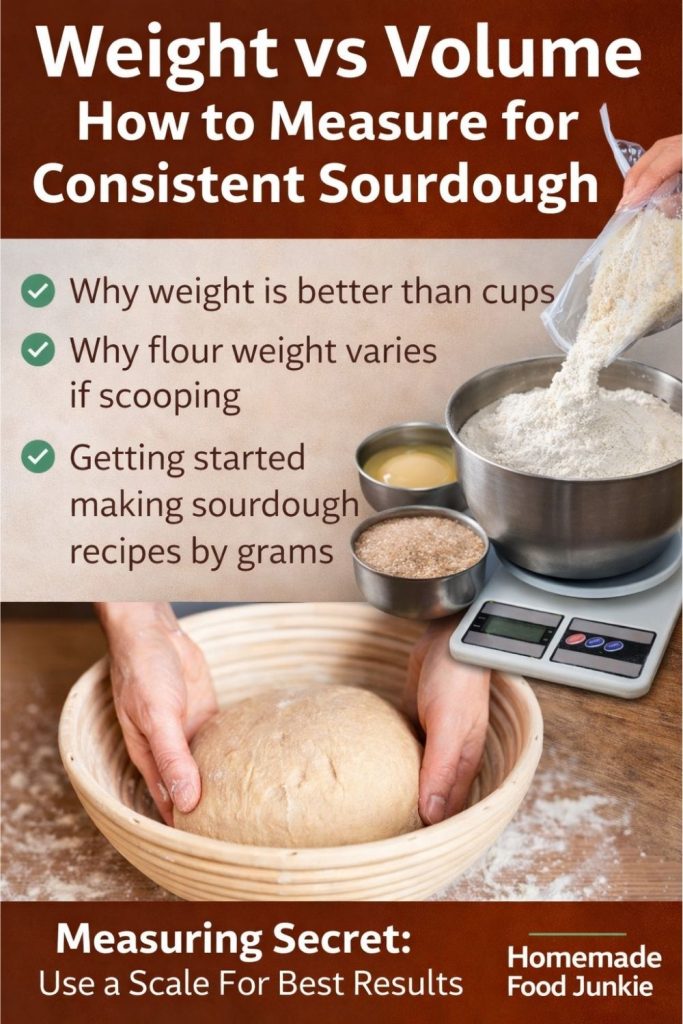
Measure Sourdough Ingredients By Weight: The Simple Switch That Improves Every Loaf
As an Amazon Associate and member of other affiliate programs we earn a small commission from qualifying purchases through our affiliate link. For more information read our Entire Affiliate Disclosure.
Measure Sourdough Ingredients by Weight for Consistent Results. If your sourdough feels unpredictable—sticky one day, stiff the next, or fermenting fast one bake and slowly the next—your measuring method may be the real issue. Volume measuring (cups and spoons) doesn’t control flour weight, so it can’t reliably produce repeatable sourdough results.
American volume bakers usually scoop flour out of a bin or bag. This compresses the flour and that often throws off the recipe. Inconsistent sourdough is often a measuring problem—not a skill problem. Here is why.
When flour or water measurements shift even slightly, hydration changes, dough strength changes, and fermentation speed changes. Switch to weighing ingredients in grams and you remove a huge variable, making your dough far more predictable.
Sourdough recipes are built on a precise balance of flour, water, and salt. If you’ve ever baked the same recipe and ended up with sticky dough one day and stiff dough the next—or bulk fermentation that runs fast one time and drags the next—your measuring method is a common culprit.
In this post you’ll learn:
- The difference between volume vs. weight
- Why flour is the biggest source of variation
- How small measuring errors change hydration and fermentation
- The simplest way to switch to grams
- How baker’s percentages help you troubleshoot and customize recipes
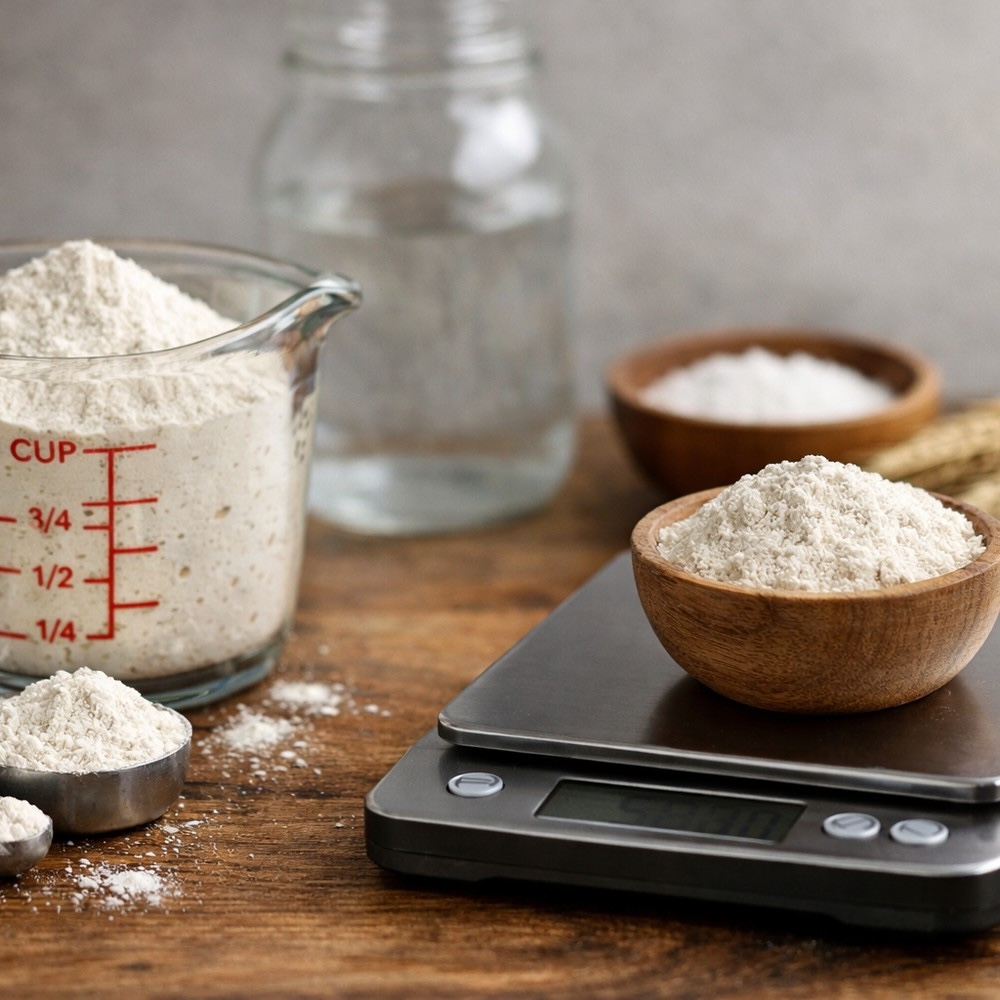
Why Measuring Accuracy Matters in Sourdough
Sourdough isn’t just “mix, rise, bake.” It’s a living fermentation, and your dough responds to tiny changes in hydration, temperature, flour absorption, and starter activity.
Even small measuring errors can lead to:
- Sticky or unmanageable dough (hard to shape, spreads out)
- Dense or gummy crumb (underdeveloped gluten or under/over fermentation)
- Weak oven spring (dough can’t trap gas well)
- Inconsistent fermentation timing (bulk and proof change loaf to loaf)
You’ll usually notice measuring problems early—during mixing or shaping—when the dough feels wetter or tighter than expected.
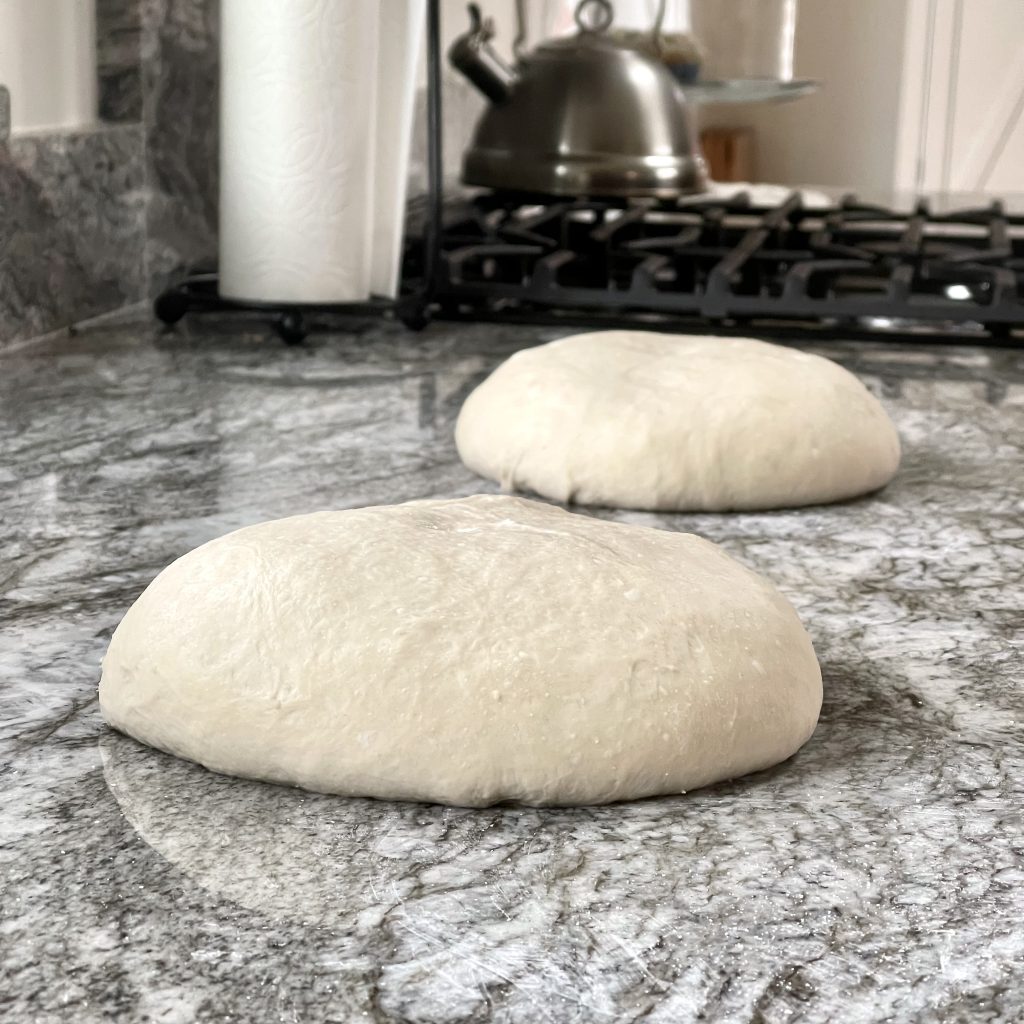
Hydration Is the Hidden Lever
Hydration (the water-to-flour ratio) controls how your dough feels and behaves.
- A little extra water can turn a “normal” dough into sticky dough.
- A little extra flour can stiffen dough and slow fermentation.
Hydration isn’t a fixed number—it’s a relationship between flour absorption, water, and technique. If you want a clearer picture of what hydration changes in real dough, read Understanding Sourdough Hydration:
The Problem With Volume Measurements
Why flour measured by “cup” isn’t consistent
A “cup” of flour can vary significantly depending on:
- Scooping method (dip-and-scoop packs flour)
- Spoon-and-level method (lighter)
- Flour type (bread flour vs. AP vs. whole wheat)
- Humidity and storage (flour absorbs moisture)
- How settled/compacted the flour is in the container
What that means in practice: two bakers using “1 cup flour” may be using noticeably different amounts of flour, which changes hydration and fermentation outcomes.
Different flours also absorb water differently. If you want to understand how flour choice changes dough behavior, see Sourdough Flour Types Guide:
Volume measurements introduce unavoidable variability — especially for flour.
The Real Sourdough Impact: Hydration Changes Without You Noticing
Flour isn’t a static ingredient. It slowly absorbs moisture from the air, and different flours absorb water at different rates. That means your dough can feel wetter or drier depending on the season, your kitchen humidity, and even storage conditions. Hydration is calculated from the actual weight of your flour—so when flour weight changes, your hydration changes too, even if you didn’t add more water.
For example:
- If your flour is heavier than expected, your dough becomes lower hydration (stiffer).
- If your flour is lighter than expected, your dough becomes higher hydration (stickier).
That’s why you can follow the same cup-based recipe and still get different results.
Read our guide on Understanding Hydration in Sourdough to see how a little change can do a lot to your whole sourdough making process.
Don’t forget salt
Salt measured inaccurately can also change fermentation speed and dough strength. If you want the full breakdown, read Salt in Sourdough Bread: Why It Matters.
And if you’re troubleshooting symptoms like sticky dough, dense crumb, or poor oven spring, our Sourdough Troubleshooting Guide is the best next step.
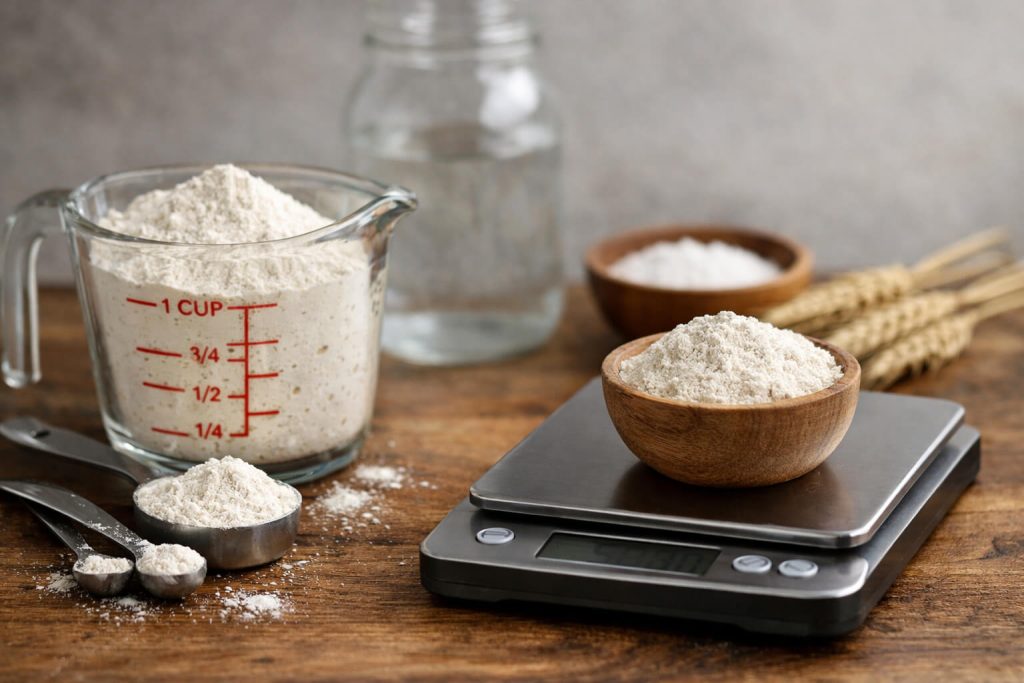
Measure Sourdough Ingredients by Weight for Superior Sourdough
A digital kitchen scale is easy to find and is one of the most useful tools you can add to your sourdough routine. Any basic scale that measures in 1-gram increments works great.
Using a scale does four powerful things:
1) You get repeatable dough behavior
Same flour weight + same water weight = your hydration is truly consistent. That means your dough handles more predictably and shaping gets easier.
2) You can scale recipes up or down cleanly
Want two loaves? A smaller batard? Using grams makes scaling straightforward and accurate.
3) You can troubleshoot with real numbers
When you’re diagnosing “sticky dough” or “dense crumb,” it helps to know whether hydration was actually 72%—or whether it drifted higher or lower because flour wasn’t measured consistently.
4) You unlock baker’s percentages
Baker’s math is the language of consistent bread baking. Once you understand it, you can adjust recipes intentionally instead of guessing.
Understanding Baker’s Percentages (Baker’s Math)
Baker’s percentages make recipes flexible and measurable.
The rule: Flour is always 100%. Everything else is expressed as a percentage of flour weight.
- Water = hydration %
- Starter (levain) = % of flour
- Salt = % of flour
- Add-ins/inclusions = % of flour
Example:
If flour is 500g (100%) and water is 350g, hydration is 70%. Salt at 10g is 2%. Starter at 100g is 20%.
Once you understand how flour, water, starter, and salt work together, you’ll have far more control over your results—especially when adjusting hydration or scaling recipes.
Learn more in these posts:
- Our Hydration post explains what hydration is and how it affects dough.
- Read our Flour post to understand flour absorption differences.
- Our Salt post explains dough strengthening + fermentation control.
- Starter post explains inoculation strength.
- Proofing is all about the timing and fermentation stages of your dough. Read more on sourdough Proofing here.
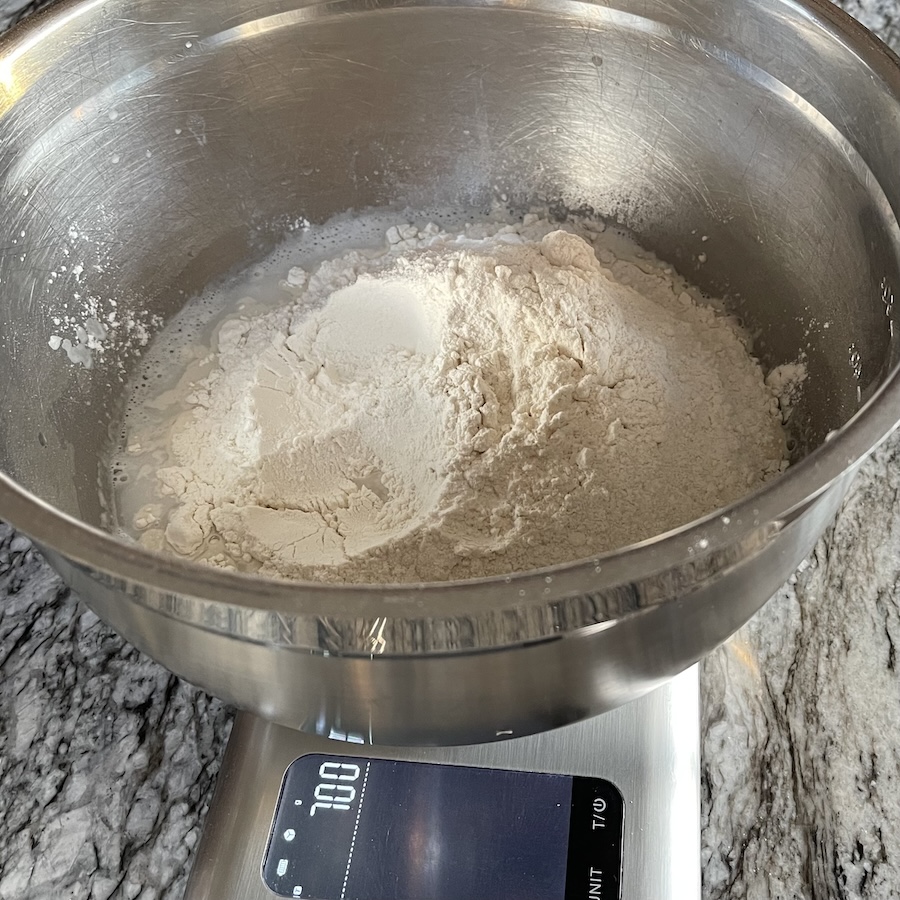
How to Switch from Cups to Grams Without Stress
If you’ve baked with cups and spoons your whole life, switching to a scale can feel unnecessary—like one more thing to learn. But it’s genuinely one of the easiest upgrades you can make, and it pays off fast. Once you start weighing flour and water in grams, your dough becomes more predictable and your results get easier to repeat.
Step 1: Start with flour and water
Even if you still use teaspoons for salt temporarily, switching flour + water to grams is the biggest improvement.
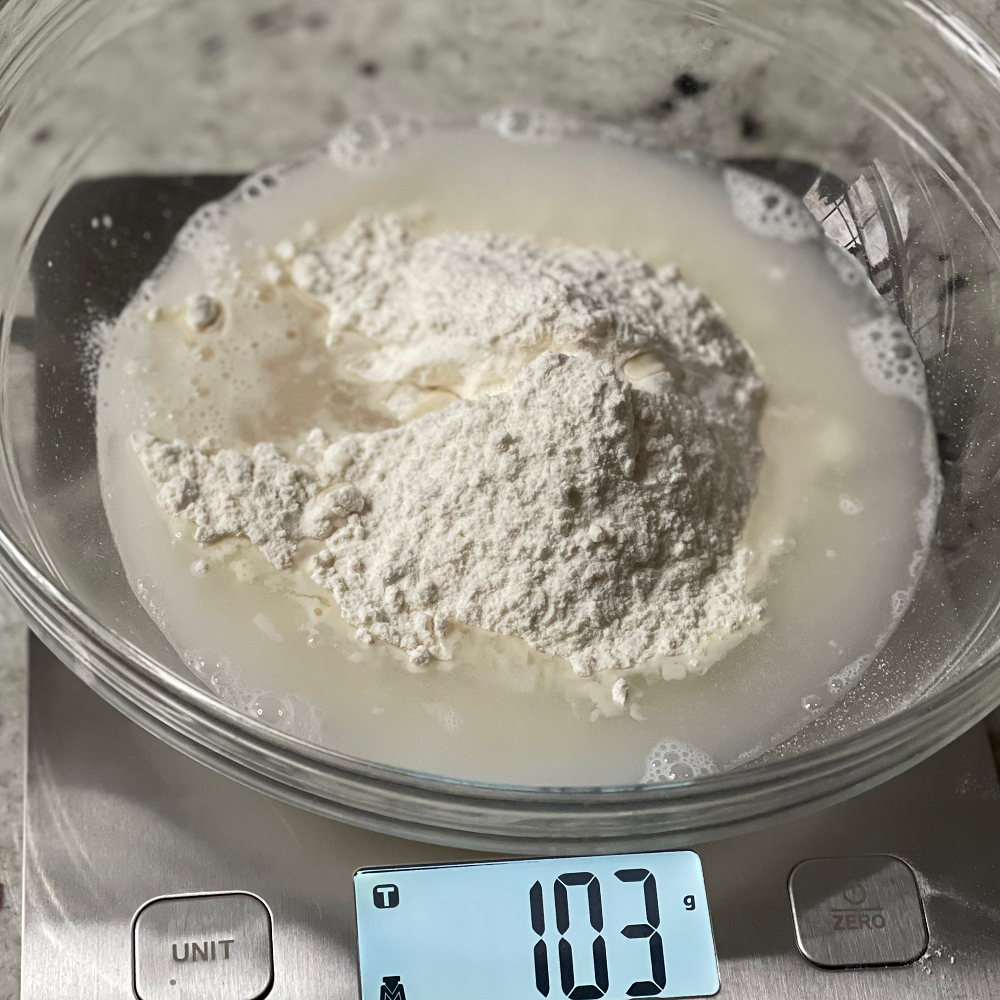
Step 2: Use the “tare” function
This is the only “learning curve,” and it’s simple.
- Put your empty bowl on the scale
- Press tare (it zeros out)
- Add flour to the gram amount
- Press tare again
- Add water to the gram amount
- Repeat for starter and salt
This keeps measuring fast and reduces dishes.
Step 3: Keep notes like a bread journal
Once your measuring is consistent, you can actually track what makes your best loaves repeatable.
Record:
- Flour brand/type
- Hydration %
- Room temperature
- Bulk time
- Cold proof time
- Bake temp
This turns “random outcomes” into a repeatable method—because you’re learning your kitchen, your ingredients, and your oven.
Measuring accurately matters when feeding and maintaining a starter too. Learn more about properly feeding your starter in this post.
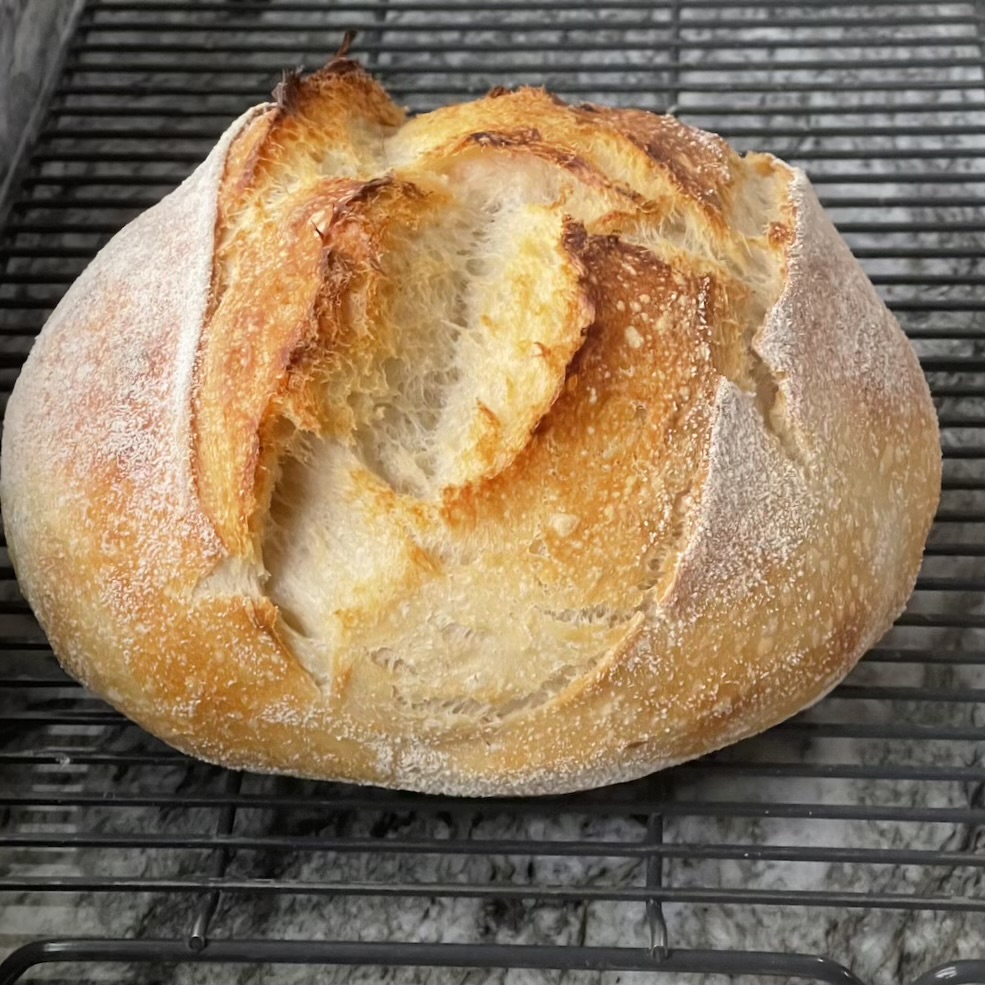
Can You Bake Sourdough Without a Scale?
Yes of course—but results will be less predictable.
If you must use cups, do this:
- Spoon flour into the measuring cup (don’t dip and scoop)
- Level with a straight edge
- Avoid packing flour down
- Stick with moderate hydration recipes until you learn dough feel
- Expect seasonal shifts (humidity + flour absorption)
The honest truth: if you want consistent sourdough long-term, a scale reduces guessing and makes every other skill easier to learn.
Measuring Tips That Fix Common Problems
Here are common sourdough issues where inaccurate measuring is often part of the problem. Read our Sourdough Troubleshooting Guide here.
If your dough is always sticky
- Verify flour weight (cups often under-measure flour)
- Consider lowering hydration slightly
- Use flour with predictable absorption (Read our flour types guide)
- Check fermentation stage (overproofing can feel sticky and slack)
If your crumb is dense or gummy
- Confirm salt measurement (too much slows fermentation; too little weakens structure)
- Confirm starter amount (inoculation affects timing)
- Confirm flour weight (too much flour stiffens dough and slows fermentation)
If bulk timing seems random
- Small hydration differences change fermentation speed
- Starter strength matters (Read our starter-feeding post for more on this)
- Temperature matters (link your proofing post when it’s published)
Frequently Asked Questions On How To Measure Sourdough Ingredients By Weight:
Still have questions? These quick answers cover the most common measuring issues sourdough bakers run into. Especially when switching from cups to grams.
Why does weighing ingredients matter for sourdough?
Weighing ingredients keeps your flour-to-water ratio (hydration) consistent. Because sourdough is sensitive to small hydration changes, a scale improves dough handling, fermentation timing, and repeatable results.
Why is measuring flour by cups unreliable?
A “cup” of flour can vary based on scooping method, how packed the flour is, humidity, and flour type. That hidden weight difference changes hydration and can make the same recipe behave differently each time.
What’s the biggest measuring mistake in sourdough baking?
The biggest mistake is unintentionally changing hydration by measuring flour inconsistently. Even small differences in flour weight can make dough sticky and slack—or stiff and slow to ferment.
What does “tare” mean on a kitchen scale?
Tare zeros out the scale with your bowl on it, so you can weigh ingredients one at a time in the same bowl. It speeds up prep, reduces dishes, and improves accuracy.
Can I make sourdough without a kitchen scale?
Yes, but results will be less predictable. If using cups, spoon flour into the measuring cup and level it off. For consistent sourdough long-term, switching to grams is one of the biggest improvements you can make
What are baker’s percentages in sourdough?
Baker’s percentages express every ingredient as a percentage of total flour weight (flour = 100%). This makes it easy to scale recipes, compare formulas, and troubleshoot hydration, salt level, or starter amount.
Should I weigh salt and starter too?
Yes. Salt affects dough strength and fermentation speed, and starter amount affects rise and timing. Weighing both helps you replicate successful loaves and diagnose problems more accurately.
What kind of scale is best for sourdough?
A: Any digital kitchen scale that measures in 1-gram increments works well. A tare function is the most important feature for fast, accurate measuring.
Final Thoughts: The Key Takeaway
If you want consistent sourdough, weigh your ingredients—especially flour and water—every time. A digital scale removes the biggest variable in sourdough baking: flour weight. Once your measurements are consistent, hydration becomes predictable, fermentation timing makes more sense, and you can repeat the loaves you love.
Start simple: weigh flour and water in grams, use the tare button, and take a few quick notes on your best bakes. From there, baker’s percentages and small adjustments become easy—and your results get better with every loaf.
BOTTOM LINE: if you want consistent sourdough, weigh flour and water in grams—then build from there.